You've found a partner you trust, agreed on a rough split, and downloaded a joint venture agreement template that looks complete. The names are filled in, the percentages add up, and signing feels like the last administrative step before real work starts. That moment is exactly where most founders get hurt, because the blanks you've completed are usually the least dangerous parts of the document. The risk sits in clauses you skimmed, thresholds you didn't set, and questions the template never asked.
Table of Contents
- Understanding the Joint Venture Agreement Template as a Governance Tool
- Core Clauses for Parties, Purpose, and Contributions
- Governance, Control, and Decision-Making Clauses
- Profit Splits, Capital Accounts, and Tax Allocation Clauses
- Liability, Deadlock, and Exit Clauses Explained
- Intellectual Property, Data, and AI Schedule Clauses
- Customizing the Template for Florida and Delaware Ventures
- Choosing Between a DIY Template and Attorney Review
- Closing Checklist and Next Steps for Your Venture
Understanding the Joint Venture Agreement Template as a Governance Tool
A founder about to sign often asks the wrong question: is this form valid? Validity matters, but it won't tell you who can approve a loan, who owns customer data after a breakup, or what happens when one partner stops funding. Treat a joint venture agreement template as a governance framework, not a fill in the blank contract. It's the operating system for how two independent businesses will make decisions, share risk, and exit without litigation.
That framing is supported by how real ventures are documented. Research examining 626 joint venture contracts found that ventures are consistently governed by detailed agreements addressing how the relationship is structured and operated, as described in the Rutgers repository study of joint venture contracts. The same research found contractual complexity is generally higher in international ventures than domestic ones, and higher in civil law jurisdictions than common law jurisdictions and in countries with inefficient court systems.
What a Template Is and Is Not
A template isn't your formation document. Articles of organization or incorporation create an entity with the state. An operating agreement or shareholder agreement governs that entity internally. A joint venture agreement can sit alongside those documents, or in a contractual venture, replace an entity altogether. If those documents conflict on who manages the business, a court or arbitrator won't guess your intent. They'll parse the conflict, and you'll pay for the parsing.
The most useful distinction in the research is practical. Equity shareholding and board participation showed a 0.58 correlation in that dataset, strong but not absolute. In plain terms, ownership and control often move together, but they aren't the same right. Your template should never let a percentage do the work of a governance clause.
Practical rule: If a clause only states a percentage, it hasn't answered who decides, who pays, who owns the output, or how someone leaves.
Read the template in six buckets: parties and contributions, governance, economics and tax, liability and exit, intellectual property and data, and jurisdiction. If you're short on time, jump to the bucket where your deal is weakest. If you're building cybersecurity duties or incident duties into operations, you'll also want to build auditable incident response playbooks that match the notice and cooperation duties you promise in the agreement, because a contractual duty without an internal playbook is hard to perform under pressure.
Tip: Mark every clause that uses words like reasonable, material, or promptly without a definition or timeline. Those are your negotiation list.
Core Clauses for Parties, Purpose, and Contributions
Start at the top and draft in order. Later clauses inherit every ambiguity you leave in the first three pages, and fixing a vague purpose clause after you've set veto rights and profit splits usually means reopening the whole deal.
Parties and Authority
Name each party by its full legal name, entity type, and state or country of formation. Don't list a trade name, a founder personally when the company is the venturer, or a parent company when only a subsidiary will perform. Add who signs for each party and confirm that person has authority. If an affiliate will provide staff, equipment, or guarantees, name that affiliate's role expressly or you'll struggle to enforce duties against an entity that never signed.
Government joint venture guidance identifies six concrete subjects a detailed agreement should cover, starting with business objectives and each party's participation and management role, as summarized in Department of Defense materials on SBA legislative updates. That list also includes capital contributions and ownership rights in property, division of profits and losses, a deadlock mechanism, and termination or liquidation including buy out provisions.
Purpose and Scope
Weak language sounds like this: the parties will collaborate on business opportunities. That sentence enforces almost nothing and restricts almost nothing. Stronger language defines products or services, territory, customers, channels, and duration, plus what's expressly outside scope.
Plain English works if it's specific. For example: The venture will develop and sell the named software to dental practices in Florida through direct sales. Neither party may use the venture name or shared customer list to sell competing practice management services during the term. That version gives you something to measure exclusivity, noncompetition, and IP use against.
- Too broad: A purpose covering all related business can accidentally pull a partner's existing lines into the venture.
- Too narrow: A purpose tied to one named customer can block ordinary pivots unless you add an amendment process.
- Missing duration: Without a term or project endpoint, termination and post term rights become fights about implied intent.
Contributions and Timing
List contributions in a schedule, not a paragraph. For each item, state what it is, agreed value if any, transfer or license date, condition, and whether the venture receives ownership or only use rights. Cash is easy. Equipment, IP, personnel, introductions, and guarantees aren't.
If one partner contributes labor and the other contributes cash, say how labor is measured, who supervises it, and what happens if the person leaves. If IP is contributed, distinguish assignment from license right here, even if the detailed IP schedule appears later. Contribution timing drives capital calls later, so tie missed delivery dates to cure rights and remedies at this stage.
When outside capital may join later, clean contribution records matter to diligence. Founders researching backers who fund collaborative models often start with directories of US investors backing collaboration startups, but no investor list fixes a venture that can't prove who contributed what. Build the paper trail first.
Tip: Attach valuations or invoices for noncash contributions on signing day. Reconstructing value during a buyout dispute is expensive and rarely credible.
Governance, Control, and Decision-Making Clauses
Ownership percentages don't run a company. People with defined authority do, and your governance clauses decide whether daily operations move quickly or stall for partner approval on routine spending.
Under IFRS 11, joint control exists only when decisions about relevant activities require unanimous consent of the parties sharing control, a definition set out in the IFRS 11 joint arrangements standard. You don't need to adopt that accounting standard to learn from it. If certain decisions require both parties, name those decisions. If they don't, don't accidentally create unanimous consent by vague drafting.
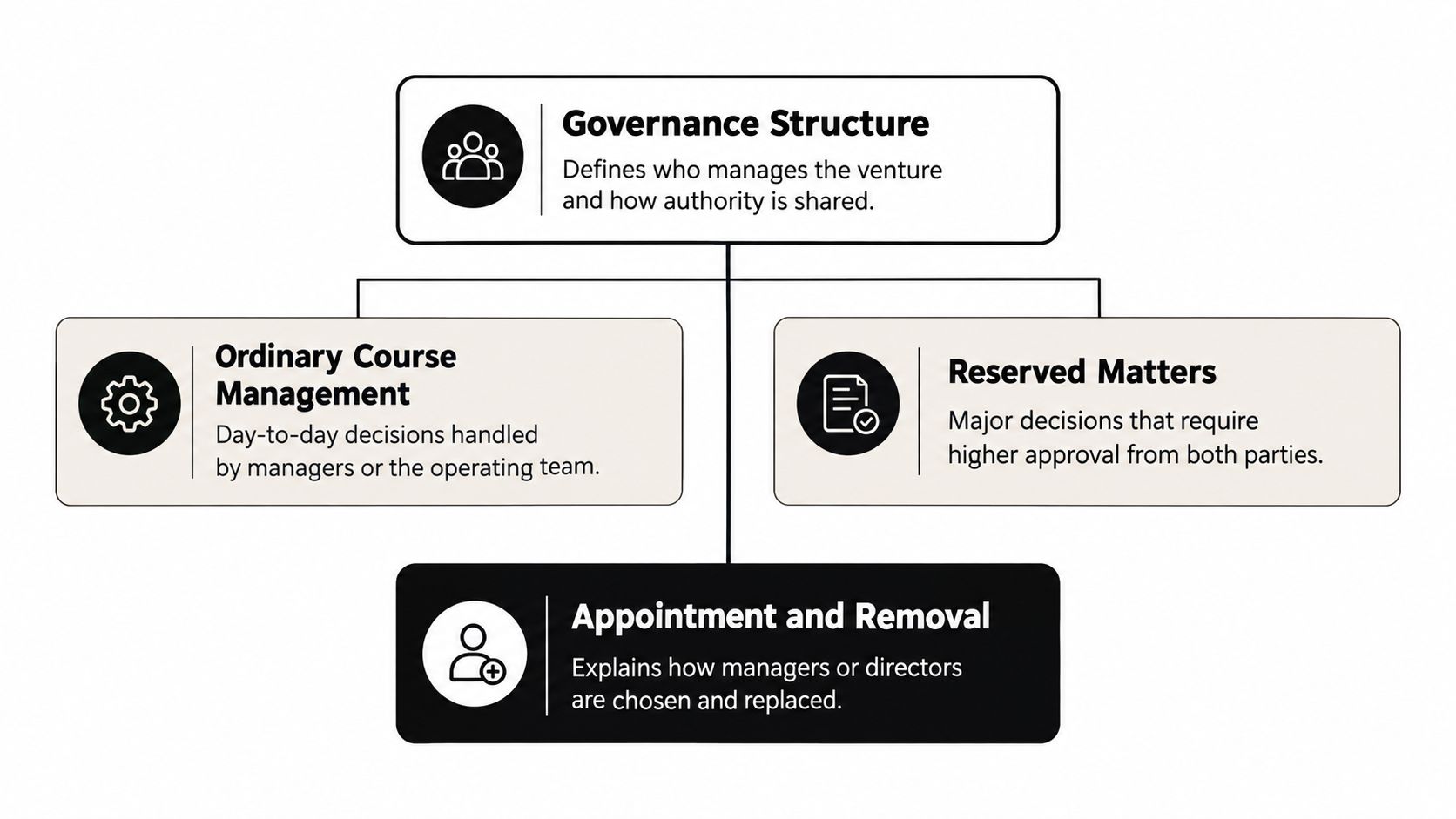
Two Decision Tiers That Do Most of the Work
Ordinary course decisions belong to appointed managers or officers within an approved budget. Hiring non executive staff, paying budgeted vendors, and performing signed customer contracts shouldn't need a partner vote. Give managers a spending ceiling, signature authority, and reporting duties, then let them operate.
Reserved matters require a higher threshold, often unanimous or supermajority consent. A workable list includes approving budgets, issuing equity or debt, entering material contracts, appointing senior management, changing business scope, acquiring or disposing of major assets, and commencing litigation. Define material by dollar value, term length, or category. Material contract without a test invites argument every time.
Consider a sample structure. A manager may approve unbudgeted expenses up to a stated ceiling. Anything above it, any borrowing, and any contract that binds the venture beyond the approved term goes to both venturers. That hierarchy protects a minority partner on fundamental risk without giving that partner a veto over office supplies.
Mechanics People Forget
Set quorum, notice periods, voting by written consent, and how managers or directors are appointed and removed. Address what happens if a party repeatedly withholds consent. Silence on that point turns a veto into indefinite paralysis until the deadlock clause is triggered, if you have one.
Align these rights with the venture's legal form and any operating or shareholder agreement. A contractual right to approve borrowing means little if statutory management authority lets one manager bind the entity anyway and third parties rely on that authority. Coordinate bank resolutions and signature cards with the agreement, not after an unauthorized transaction.
Require periodic financial reporting, inspection rights, compliance certifications, related party transaction controls, and documented resolutions. That record helps lenders, investors, tax advisers, and later acquirers, and it disciplines partners while relations are still good.
A minority veto over budgets and debt can be reasonable investor protection. A minority veto over every hire and vendor is shared management, whether you call it that or not.
Tip: Put thresholds in a schedule. You'll update dollar limits as the venture grows more often than you'll rewrite governance principles.
Profit Splits, Capital Accounts, and Tax Allocation Clauses
Economic rights answer who gets paid and who bears losses. Control rights answer who decides. Templates cause trouble when they use one percentage to answer both questions and assume tax reporting will follow automatically. It won't.
A partner can hold a minority economic interest and still hold veto rights over fundamental actions. Another can manage daily operations and receive a salary or management fee before profits are split. A third arrangement may distribute cash by work performed rather than capital contributed. All of that is negotiable, but only if the template separates the concepts.
Economic Rights and Control Rights in a Joint Venture Template
| Right Type | What the Template Should Define | Why It Needs Its Own Clause |
|---|---|---|
| Profit and loss share | Percentage or formula, timing, and whether work performed affects the split | Prevents a default equal split that doesn't match contributions |
| Distributions | Mandatory or discretionary payments, tax distributions, reserves, and approval needed | A profit allocation isn't cash in a partner's account |
| Capital accounts | How accounts are credited, debited, and used at liquidation | Connects bookkeeping to who receives value at exit |
| Fees and salary | Management fees, service payments, and reimbursement rules | Separates pay for labor from return on ownership |
| Voting and veto rights | Thresholds for ordinary and reserved matters | Control can differ from economics by design |
| Transfer and exit value | Buy out pricing, payment terms, and liquidation priority | Value at exit depends on accounts and priority, not slogans |
Why Tax Allocations Need Separate Drafting
In a partnership style venture, tax allocations must coordinate with capital accounts and liquidation. IRS guidance states that an allocation generally has economic effect when the agreement requires a capital account for each partner, liquidation according to positive capital account balances, and restoration of deficit balances after liquidation, as explained in IRS guidance on partnership economic effect rules. If an allocation lacks substantial economic effect, allocations follow the partners' interests in the partnership.
Don't copy a commercial profit split into the tax clause and stop. Review contributions, distributions, capital accounts, deficit obligations, and liquidation language together. Unequal cash, contributed property, expected losses, or unequal work obligations make that review essential, because partners can receive tax consequences that don't match cash received.
Federal contracting adds a warning against blind copying. In SBA mentor protégé ventures, profits must be commensurate with work performed rather than automatically equal, a program specific point discussed later in practical customization. Private deals aren't bound by that rule by default, but the principle is sound. State your intended split and the reason it fits contributions and work.
Tip: Run a simple loss year and liquidation example with your tax adviser before signing. If the numbers surprise either partner, your clauses don't match the deal you think you made.
Liability, Deadlock, and Exit Clauses Explained
These clauses decide what happens when money runs short or partners stop agreeing. They're also where a template's list format fails you, because liability, capital calls, deadlock, and exit aren't separate topics in a real crisis. They happen in sequence.
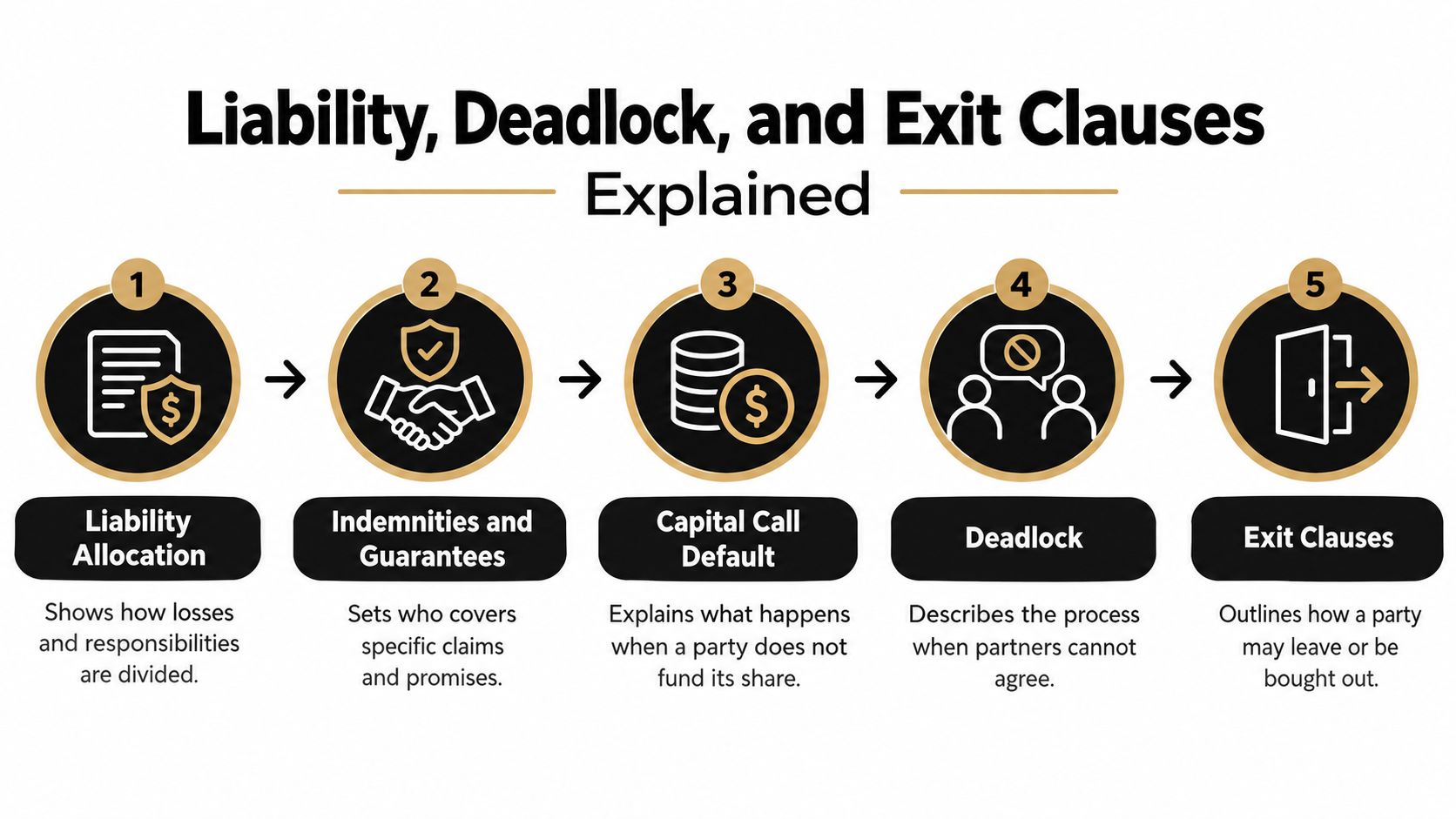
Follow the Escalation Path in Order
First, define liability allocation internally and externally. Partners can split losses one way between themselves while facing different exposure to customers or lenders. The ICC model approach highlights that participants may share counterparty risk and, in construction settings, can face joint and several liability to the customer even when internal allocations differ, a point reflected in the Business in a Box joint venture agreement discussion of model terms. Answer directly whether any partner personally guarantees debt, a lease, or performance.
Second, draft indemnities with a clear trigger, covered claims, caps, exclusions, and defense control. If you need the underlying concept in plain terms, review how indemnification works as a legal allocation of loss before you negotiate caps. Don't accept a broad indemnity for everything arising from the venture. Tie it to breach, negligence, IP claims, regulatory violations, or a partner's separate business, as the deal requires.
Third, handle capital call default. State notice, cure period, interest if any, and remedies. Can a nondefaulting partner fund the shortfall as a loan, as extra capital that dilutes the defaulter, or both? Can voting or distribution rights be suspended? Without those answers, the partner with cash gains an advantage the document never granted.
Fourth, define deadlock. A workable path escalates to senior representatives, then mediation, then expert determination for technical disputes, then a buy sell process, controlled third party sale, or dissolution. Put a time limit on each stage. Founders who are also connecting project risks to traction signals for fundraising should map these triggers the same way, because an unresolved governance risk becomes a diligence risk.
Fifth, draft exit as a process, not a label. Cover voluntary transfer, right of first refusal, tag along and drag along concepts if relevant, valuation method, payment terms, noncompete or nonsolicitation limits where enforceable, and return of property and data. If one partner contributed money and another contributed IP or labor, test whether your buyout formula credits both fairly or lets one side capture the other's contribution at a discount.
Tip: Never use a shotgun buy sell clause when partners have sharply unequal access to cash. The richer partner can trigger it strategically, and the clause will do exactly what you signed.
Intellectual Property, Data, and AI Schedule Clauses
Most generic templates handle IP in two sentences. Pre existing IP stays with its owner, and work product belongs to the venture. That language collapses the moment software, content, customer data, or AI tools enter the business.

Start with four categories and assign each one. Background IP is what each partner owned before signing. Contributed IP and data is what a partner brings for venture use. Jointly developed IP is created together during the term. Outputs are deliverables, reports, content, models, or other results produced for customers or for the venture itself. For each category, state ownership, license scope, territory, exclusivity, sublicensing, and rights after termination.
If you're still sorting what protection applies to software, brands, and creative assets, a practical overview of how to protect intellectual property can help you separate trademark, copyright, trade secret, and contract issues before you draft. Contract language can't create rights a partner never owned, and it can't transfer some personal data rights or third party licensed assets at all.
Add a Separate AI and Data Schedule
Recent legal guidance identifies jointly developed IP, self learning technologies, data driven applications, cybersecurity, and cross border data transfers as central joint venture issues, while noting ownership of training data and use of AI outputs after termination can be difficult to resolve, as discussed in the Chambers joint ventures practice guide. Close that gap with a schedule covering:
- Data provenance and permissions: Where data came from, what consent or license supports its use, and who warrants that permission.
- Model and output ownership: Who owns prompts, fine tuned models, improvements, embeddings, and generated outputs.
- Training and reuse rights: Whether contributed data may train models, and whether either partner may reuse outputs after exit.
- Security and incidents: Access controls, audit rights, incident notification timing, and cooperation duties.
- Compliance and indemnities: Who owns regulatory review, infringement risk, discriminatory or inaccurate output risk, and model provider terms.
- Return or deletion: What gets returned, deleted, or retained at termination, and how deletion is certified.
Technology, e commerce, healthcare, and creative ventures feel these gaps fastest. Open source components, model provider restrictions, and customer contracts can all limit what the venture may assign to a departing partner.
Competitors need an additional guardrail. FTC and DOJ collaboration guidance treats the nature and structure of a collaboration as relevant to anticompetitive harm, as set out in the FTC and DOJ guidelines for collaborations among competitors. Limit information exchange to what's reasonably necessary, use clean team and access controls where appropriate, and don't share current or future prices, bids, margins, capacity, or customer specific terms without legal review.
Tip: Inventory every dataset and AI tool by owner, license, and permitted use before launch. A schedule built from memory after a dispute starts isn't evidence, it's advocacy.
Customizing the Template for Florida and Delaware Ventures
Governing law isn't boilerplate. It decides which default rules fill gaps, where you may have to litigate or arbitrate, and how management authority interacts with state entity law. Pick it deliberately, then align every formation document with that choice.
Research on 251 international joint venture contracts signed between 2000 and 2016 found control clauses were used more frequently when legal environments and court systems differed substantially, and that selecting governing law from a country other than the host location reduced the need for some control provisions, as reported in the Academy of Management study of international joint venture contracts. Domestic founders face a smaller version of the same choice when a Florida operating business uses a Delaware entity or a foreign partner.
Florida Ventures
For a venture operating in Miami, Fort Lauderdale, or broader South Florida, confirm the agreement matches the Florida LLC operating agreement or corporate bylaws on manager authority, member votes, transfer restrictions, and dissolution. If the venture is purely contractual with no new entity, be especially clear on agency authority. Each partner needs to know when the other can bind the venture to customers and vendors.
South Florida deals often involve bilingual partner communications. Decide which language controls if documents are translated, keep one authoritative signed version, and make sure notices, capital call deadlines, and dispute escalation steps are understood the same way by both sides. Translation helps communication. It shouldn't create two contracts.
Delaware Entities
Delaware is common for investor facing corporations and contractual flexibility in alternative entities, but you still need local operating reality addressed. Review the practical benefits and trade offs of Delaware incorporation alongside tax, foreign qualification, and where the business operates. Forming in Delaware while operating only in Florida usually adds Florida foreign qualification and registered agent duties, not an escape from Florida obligations.
For federal contracting ventures, customization isn't optional. SBA mentor protégé rules require the small business participant to act as managing venturer controlling day to day management, and in a separate legal entity venture that participant must own at least 51%, as summarized in the Congressional Research Service overview of SBA joint ventures. SBA rules also require the small business partner to perform at least 40% of the work performed by the joint venture, and that work must be more than administrative or ministerial, as explained in SBA contracting assistance program guidance. Don't copy those program percentages into a private deal unless the program applies.
Tip: Choose forum or arbitration based on where witnesses, assets, and enforcement targets sit, not habit. A favorable clause you can't enforce against the other party's assets has limited value.
Choosing Between a DIY Template and Attorney Review
There are three realistic paths, and honesty about complexity matters more than frugality. A cheap document that misstates tax allocations or exit rights isn't cheap. It's deferred cost with interest.
Option one is a template with no review. That can be reasonable for a short, low value, non entity project with no employees, no regulated data, no borrowed money, and easily separated assets. Even then, you should complete schedules, thresholds, and termination mechanics. Signing a form with blanks and bracketed alternatives left inside is not a finished agreement.
Option two is a customized template using a checklist. This fits founders who can negotiate business terms themselves but need discipline on governance tiers, contribution schedules, IP categories, and deadlock steps. You'll still carry risk on tax allocations, securities issues if investors are involved, antitrust limits between competitors, and enforceability of restrictive covenants. Use this path to get to a clean draft, not necessarily a final signature.
Option three is attorney drafting or review. Choose it when the venture involves equity in a new entity, outside investors, meaningful IP licensing, personal guarantees, regulated data, cross border partners, federal contracting rules, or a partner who could compete after exit. Counsel should also reconcile the joint venture agreement with operating or shareholder documents, bank authority, insurance, and key customer contracts.
In that third category, Coto & Waddington, Attorneys at Law handles business first drafting for startups, small companies, and family owned businesses, with bilingual English and Spanish support and flat, predictable pricing for defined engagements. That factual fit matters for South Florida founders who need a Florida or Delaware venture reviewed without open ended scope. Other founders may prefer their existing corporate counsel or a tax led review first, depending on whether governance or tax is the dominant risk.
Compare options by downside, not drafting fee alone. Ask what a missed capital call remedy, an unusable buyout formula, or lost rights in jointly developed software would cost. If that number dwarfs review cost, the decision is made.
Decision test: If you can't explain, in one sentence each, how deadlock ends, how taxes are allocated, and who owns outputs after termination, you're not ready to sign without review.
Tip: Bring counsel a term sheet and contribution schedule, not just a template. Review gets faster and cheaper when the business deal is already decided and written down.
Closing Checklist and Next Steps for Your Venture
Use this checklist as verification questions, not a skim. Every no answer is either a drafting task, a negotiation point, or a conscious risk you should record before signing.
Pre Signing Verification
- Parties and purpose: Are legal names, signatory authority, business scope, territory, exclusions, and term all stated without relying on side emails?
- Contributions: Does each cash, asset, IP, personnel, and guarantee contribution have a value where needed, a delivery date, and an ownership or license label?
- Governance: Does every reserved matter have a voting threshold, and do quorum, notice, and appointment rules match the operating or shareholder agreement?
- Economics: Are profit shares, distributions, fees, reserves, and transfer value defined separately from voting control?
- Tax: Do capital accounts, deficit duties, allocations, and liquidation language work together, and has a tax adviser tested a loss year example?
- Liability: Is personal guarantee exposure explicit, and are indemnity triggers, caps, exclusions, and insurance duties clear?
- Capital calls and deadlock: Does each missed funding and deadlock stage have a cure period or time limit, a named decision maker, and a final exit mechanism?
- IP, data, and AI: Are background IP, contributed data, jointly developed assets, training rights, and post termination reuse assigned in a schedule?
- Compliance: If partners compete, are information sharing limits, clean team controls, and regulator inquiry duties written into operations?
- Jurisdiction: Do governing law, forum or arbitration, notice method, and entity documents point in the same direction for Florida, Delaware, or cross border enforcement?
Keep the agreement current after signing. Schedule a review after a major funding round, a new partner or investor, a pivot outside the original purpose, first borrowing, first regulated dataset, or entry into a new state or country. Amend in a signed writing. Course of dealing can change how partners behave, but it creates messy evidence when the written agreement says something else.
Store the signed agreement with schedules, contribution proof, IP assignments or licenses, bank resolutions, insurance certificates, and capital account records in one controlled folder. Give each venturer the inspection access the agreement promises. Most enforcement fights start with missing records before anyone reaches legal interpretation.
Tip: Calendar every deadline in the agreement on signing day, including contribution dates, reporting dates, cure periods you may need to invoke, and the term or renewal date. Rights with deadlines protect the partner who tracks them.
If your checklist produced more open questions than confirmations, don't patch the template with margin notes. Get the draft reviewed, customize it for your Florida or Delaware structure, and sign a version that answers deadlock, liability, tax, and data questions before your partner relationship has to.
If you want a joint venture draft reviewed line by line, a template customized for a Florida or Delaware entity, or a full agreement built around your contributions, governance, and exit terms, contact Coto & Waddington, Attorneys at Law to start with a consultation. Bring your current draft and contribution schedule, and you'll leave with a clear list of clauses to fix before you sign.