Search "Florida vs Delaware LLC" and nearly every answer says the same thing: form in Delaware. The claim gets repeated in forums, in accelerator onboarding decks and by accountants who mean well. Most of the time it's a reflex borrowed from venture-funded software companies and applied to a landscaping business in Davie or a two-owner agency in Coral Gables.
Delaware isn't a bad state. It's a second state to maintain, and for a company that never trades outside Florida it's an annual bill with nothing on the other side of the ledger. The advice goes wrong because it answers the wrong question. Not where the company is incorporated, but where the company operates.
Those are two separate decisions with two separate price tags. A Delaware LLC that runs its business from Florida pays Delaware and it pays Florida. That's the part most comparisons skip, and it's the part that changes the math.
Table of Contents
- The Short Answer on Florida or Delaware for Your LLC
- What Each State Charges to Form and Keep an LLC Active
- How to Stay Compliant After Your LLC Is Formed
- Governance, Privacy and Investor Expectations
- Which State Fits Your Business Situation
- Choose Your State Before You File Articles
The Short Answer on Florida or Delaware for Your LLC
The verdict: For an owner-operated business whose customers, employees and activity sit in Florida, a Florida LLC is usually the lower-cost, simpler base. Delaware earns its recurring annual tax when investors, multi-state deals or investor-negotiated governance actually require it, and not before.
The popularity argument deserves a fair hearing, then a hard look. The Delaware Division of Corporations recorded 211,464 LLC formations in 2024, down from 218,708 in 2023. That number tells you what a large population of companies does. It tells you nothing about whether a two-owner e-commerce brand shipping out of a Doral warehouse benefits from the same structure.
Forming in one state and operating in another
A formation state governs the company's internal law. An operating state governs everything the company physically does: its office, its staff, its inventory, its contracts and its lawsuits. When those are the same state, you carry one registration, one annual obligation and one set of records. When they're different, the Delaware entity that does business in Florida has to register in Florida as a foreign LLC and then keep filing there too. The Delaware tax doesn't disappear because you added Florida.
That's the trap. Founders budget the formation fee, then discover at the end of year one that they're maintaining two entities' worth of paperwork for one small company.
What you're actually comparing
Not the advertised filing fee. The right comparison is total cost and administrative load over several years, which means adding the annual state charge, the registered-agent arrangement in each state, the late-payment exposure, and the hours you spend on filings you didn't need. Price the whole five-year window before you decide, because the gap between the two states shows up in years two through five, not in the filing receipt.
What follows prices both states line by line, gives you the compliance calendar, tests the governance and privacy arguments, and closes with a verdict by business situation and a pre-filing checklist.
Where you operate decides more than where you incorporate.
What Each State Charges to Form and Keep an LLC Active
Here's the whole comparison in one place. Every figure below is a state charge, not an estimate.
| Cost item | Florida LLC | Delaware LLC |
|---|---|---|
| Formation filing | $100 | $110 |
| Registered agent | $25, required at formation | Required, billed by the provider |
| Initial total | $160 before optional items | $110 plus registered agent |
| Recurring state charge | $138.75 annual report | $400 annual tax |
| Deadline | May 1 for the annual report | June 1 for the annual tax |
| Late cost | $538.75 total after May 1, which is $400 more | $200 penalty plus 1.5% monthly interest |
Two billing models, one question
Florida's model is a filing. The Florida Department of State fee schedule lists $100 for a domestic or foreign LLC filing and $138.75 for the annual report. Add the required $25 registered-agent fee and a new Florida LLC starts at a stated $160 before optional items such as a certified copy or a certificate of status. Miss the May 1 window and the same report becomes a $538.75 total, a $400 swing on a filing that takes minutes to complete.
Delaware's model is a tax. The Delaware Division of Corporations instructions state that domestic and foreign Delaware LLCs don't file an annual report but must pay a $400 annual tax by June 1. It isn't prorated: if the entity is active in the state's records at any point in the January 1 to December 31 period, the full amount applies. Late payment brings a $200 penalty, with interest accruing at 1.5% per month on the tax and penalty.
One warning that saves money: older Delaware FAQ material listed the tax at $300, and current instructions list $400. Guides written a few years ago still quote the old figure. Confirm the amount on the state's own page before you budget.
Five years of both, run twice
Florida: $160 initial, plus five annual reports at $138.75, comes to $853.75.
Delaware: $110 initial, plus five annual taxes at $400, comes to $2,110, with the registered-agent bill left out of both columns because providers price it differently.
The recurring gap is the number worth memorizing: roughly $260 a year, every year, before anyone files a single page of extra paperwork for a second state. If you're funding the company from savings rather than a term sheet, that gap lands straight in your budgeting runway for solo founders, which is why it's worth pricing over several years and not against this month's bank balance.
A detail founders miss: form a Delaware LLC in December and the full $400 is already owed for that calendar year, even though the company existed for a few weeks.
The part taxes don't change
Federal treatment is identical in both states. A multi-owner LLC is taxed by default as a partnership, a single-owner LLC as a disregarded entity, and no state changes either default. What differs is state-level cost. Florida has no personal income tax, and a Florida LLC taxed as a partnership doesn't pay the Florida corporate income tax, which applies to C-corporations. Delaware's $400 is a flat charge that doesn't look at income. A Delaware LLC with Florida operations may still owe Florida filings and taxes tied to that activity, so confirm the full picture with a tax adviser before you file anything.
The cheap state to form in is the one you don't have to register in twice.
How to Stay Compliant After Your LLC Is Formed
Compliance after formation is a calendar problem, not a legal puzzle. Here's the routine, and the reason behind each entry.

The Florida Division of Corporations annual report page lays out the charge and the deadline. What it can't do is put them on your phone on the day you file.
- Calendar May 1 the day the LLC is formed. The annual report is due between January 1 and May 1, and the fee jumps to a $538.75 total if the report arrives after that date. One entry, made while the formation documents are still warm, prevents the most expensive slip in this routine.
- Confirm the current fee before you pay it. Statutory and administrative amounts change, and guides go stale. Check the Division of Corporations site each year rather than trusting a number copied from an old article.
- Keep the company's record information current. The annual report confirms the details the state uses to identify the LLC and its authorized representatives, so a stale manager or address is a data problem you're re-certifying every year.
- Register in Florida if you formed in Delaware and trade here. A Delaware LLC conducting business in Florida needs a certificate of authority, and the process is straightforward if you follow the Florida foreign LLC registration steps in order. Once registered, the Florida annual report joins the calendar too.
- Put Delaware's June 1 deadline on the same calendar. Treat it as firm, because the late penalty and monthly interest apply on top of the tax you already owed.
- Keep registered-agent contracts and addresses current in both states. A lapsed agency or a stale address is how default notices get missed. If your agent uses a commercial mail address, banks and payment processors can push back on it, and Cloud Residents on Stripe address checks explains what those systems look for.
Practical rule: the late Florida report is the single most expensive mistake in this list, and it's avoided with one calendar entry made on filing day.
The underlying obligations come from Florida's Revised LLC Act, which places the annual report requirement and the department's filing fees in the same chapter. That's worth knowing when a letter arrives quoting a statute: the duty is continuing, not a one-time filing.
Governance, Privacy and Investor Expectations
The strongest argument for Delaware isn't cost. It's that the state's LLC Act is built for contract-centered governance, where the operating agreement can allocate fiduciary duties, voting rights, information rights, transfer restrictions and manager authority in fine detail. Florida's Revised LLC Act is the more direct choice when the owners, employees and assets sit in Florida, and it avoids running two statutes for a business that rarely leaves the county.
Testing the reputation claim with a real disagreement
Take a three-owner services LLC in Miami. One partner wants out and disputes the price. Nothing about that fight turns on whether the certificate was filed in Dover or Tallahassee. It turns on whether the operating agreement defines a buyout formula, a valuation method, a notice period and a deadlock mechanism. A well-drafted business operating agreement template used as a starting point beats a Delaware filing with a thin agreement behind it every time.
That's where our work usually starts. Coto & Waddington, Attorneys at Law helps business partners, co-founders and LLC members with ownership conflicts, management disputes, buyouts and exits, and those problems are drafted into or out of existence long before they reach a courtroom.
Delaware's advantage is real for a company that will raise institutional money or renegotiate governance repeatedly. For everyone else it's a premium paid for a framework they'll never stress.
What privacy actually covers
State filing privacy is narrower than the internet suggests. Delaware doesn't require an annual report, which keeps routine filings out of the public record. It doesn't shield a company that operates in Florida from Florida's own records, and it doesn't remove the recurring state charge. Anyone promising privacy as the main reason to form in Delaware is describing a partial benefit as a total one.
The controls that decide whether you're protected
Liability protection comes from operating discipline, not from a state seal. The work that matters:
- A drafted operating agreement that covers voting, distributions, transfers, deadlocks and exits.
- Documented separateness between personal and company accounts, with no commingling.
- Adequate capitalization for the business the company runs.
- Insurance matched to the business's exposures, not the cheapest policy.
- Written contracts with customers, vendors and contractors.
- Clear intellectual property ownership, assigned to the company in writing.
For most small businesses, those six items decide more than the state of incorporation ever will.
Which State Fits Your Business Situation
Use this as a starting filter, then read the three profiles under it.
| Business situation | Better state | Deciding factor |
|---|---|---|
| Florida-owned online store or local retail shop | Florida | No second-state registration and no $400 Delaware tax |
| Creative agency or professional services firm in South Florida | Florida | Clients and staff are in Florida, so single-state administration fits |
| Startup expecting venture capital rounds | Delaware | Investors expect contract-centered governance and a familiar framework |
| Multi-owner company expecting buyout or management disputes | Delaware, if investors require it | A customized operating agreement matters most; compare the added annual cost first |
| Florida operations with out-of-state investors and no Delaware requirement | Florida | Avoids the second registration unless a lender or client insists |
Three profiles, three answers
The Doral e-commerce brand. Two owners, a warehouse in Miami-Dade, customers across the country. A Florida LLC means one registration, one annual report and no second-state tax. The interstate sales don't change where the company is formed. This is the default, and it holds unless a lender or a marketplace demands otherwise.
The Fort Lauderdale software startup. A seed round is twelve months out and the lead investor's term sheet expects Delaware. Paying the annual tax is the cheap part of that decision, because the financing depends on a governance framework the investor's counsel already knows. The thing to get right is the entity type: a C-corp, especially one formed in Delaware, is the usual vehicle for venture capital, while an LLC is the flexible fit for most small businesses. An S-corp election is a separate tax question to settle with an adviser.
The Hollywood creative agency. One Florida office, a handful of freelancers in other states, no outside investors. Florida wins here too. Contractors in Georgia or Texas don't require Delaware registration, and a client contract is easier to negotiate than a second state's compliance calendar.
What flips the verdict later
Three events change the answer: a priced investment round, a physical move into another state, or a planned sale. When one of those lands, revisit the structure instead of inheriting a choice made for a smaller company. We guide clients through entity options and implement the structure that fits, and the conversation is usually shorter the second time because the business has real facts to work with.
If a round is coming, get the investor documents aligned with the formation before you sign anything, using the startup investor agreement template as a reference for what those documents typically cover.
Choose Your State Before You File Articles
The order matters. Decide the state first, then file, then set the calendar. Reverse it and you'll be registering a second time within a year.
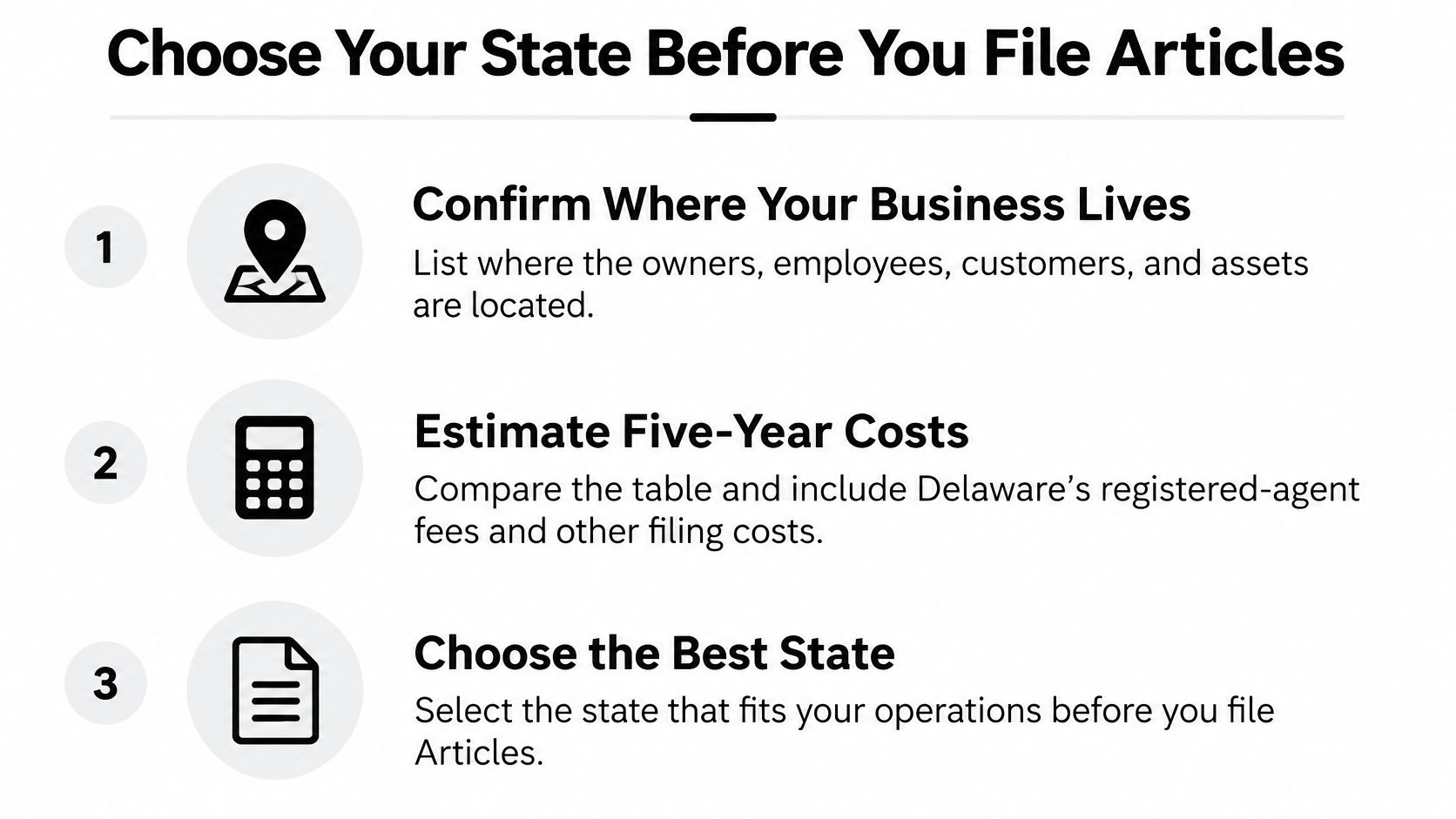
- Confirm where the business lives. List where the owners, employees, customers and assets are located. If the answer is overwhelmingly Florida, that's your operating state and it's probably your formation state.
- Estimate five years, not one. Run the table with Delaware's registered-agent cost and any Florida foreign registration included. The formation fee is the smallest line in the comparison.
- Ask the people who will fund or lend to you. Lead investors and commercial lenders are the two parties who can require Delaware. Ask before you file, not after.
- Write the choice into the documents. The state of formation, the operating agreement and the ownership records should tell the same story on the same day.
- Calendar the first deadline on filing day. Whatever state you pick, the first recurring obligation is the one most often missed.
Three habits keep the decision sound: verify current fees on the state websites before you file, don't treat Delaware as a privacy product, and budget a properly drafted operating agreement from day one rather than downloading one after a dispute starts.
The Delaware Division of Corporations FAQ makes the recurring nature of the annual tax plain, which is useful context for the question that decides this. A Delaware formation doesn't replace the operating agreement, the capitalization, the contracts, the insurance or the IP ownership. Those are the controls that protect you, and they cost money in either state.
Will Delaware actually improve your outcome, or will it add a second state's deadlines and records to manage?
Answer that and the state choice usually makes itself. If the only reason on your list is reputation, save the annual difference and spend it on the agreement that would defend you.
Coto & Waddington, Attorneys at Law forms LLCs, S-corps and C-corps in both Florida and Delaware, and registers most entities in 3 to 5 days so you can start operating without a second trip to the state. The startup legal package bundles entity formation, EIN registration, an operating agreement, contract templates for MSAs, NDAs and SOWs, and a compliance checklist that puts your first deadline on the calendar, with trademarks and investor preparation available as add-ons. Pricing is flat and predictable, and you'll see a transparent proposal before any work begins, so visit Coto & Waddington, Attorneys at Law and settle the state question before you file.