No, federal trademark registration isn't legally required to start using a business name in the United States, and if you do decide to file, the base government fee is $350 per international class. Rights from use exist without any filing at all, but they're usually limited to the area where customers already know the name, which for most founders means one city or one market.
You've filed the LLC through Sunbiz, bought the domain, told a few friends, and you're pricing out signage. Somewhere between those steps you typed "do I need to trademark my business name" into a search bar, and every answer you found opened with "it depends."
Most answers skip the key point. The decision that matters isn't register or don't register. It's whether the name is clear to use at all, and how far your customers will be from South Florida over the next year or two. Those two questions set your timing, your cost, and your exposure, and they change as the business grows.
What follows is the practical version: what unregistered rights really cover, when filing stops being optional, how clearance works step by step, what the USPTO charges, and which deadlines you'll be managing for as long as you own the mark.
Table of Contents
- Whether You Need to Register Before You Start
- When Federal Registration Is Worth the Cost
- How to Clear Your Name Before Spending on Branding
- Choosing the Right Filing Basis and Owner
- What Filing and Attorney Work Typically Cost
- Keeping Your Registration Active Through Renewals
- Confirm Your Clearance Before You Launch
Whether You Need to Register Before You Start
You don't. The USPTO's overview of why businesses register states plainly that trademark rights can arise automatically through actual use of a name in commerce, which is what lawyers call common-law rights. No filing, no fee, no examination.
What those rights cover is where founders get surprised. Say a Miami bakery sells only at one weekend market and through a neighborhood pickup window. It builds real recognition in that pocket of the city, and its rights attach there. They don't reach Broward, they don't reach Tampa, and they certainly don't reach a nationwide online storefront.
What an LLC filing actually protects
A Florida entity registration, a fictitious name certificate, a domain purchase, or a county business license identifies a company. A trademark identifies the source of goods or services. Those are different jobs, and paperwork from Tallahassee doesn't stop a stranger in Arizona from using your name on their products.
The limits of unregistered rights come down to three things:
- Geography. Protection typically tracks the area where the mark is used, which for a local shop means the neighborhood where customers recognize it.
- Enforcement. Proving you used a name first, and where, requires records most new businesses never kept.
- Expansion. The day you ship outside that footprint, you're relying on rights you may not be able to assert there.
Practical rule: Keep dated proof of first use from day one, including invoices, order receipts, archived web pages, and photos of your signage with a visible date. If priority is ever challenged, that file is your case.
A note on symbols, since founders ask constantly. You can place ™ next to an unregistered name today. ® is reserved for marks that have issued on the federal register, and using it early creates a problem of its own.
Registration stays optional at launch. It stops being optional in practice once the people buying from you sit outside your local area. When the sign does get built, keep the artwork clean enough to reuse; these logo resizing and optimization tips handle the production side that trademark law doesn't touch.
When Federal Registration Is Worth the Cost
The honest answer is situational, not philosophical. Match your business to a row.
| Your situation | Registration recommendation | Main reason |
|---|---|---|
| Single local storefront, sales only nearby | Optional, but run clearance first | Local common-law rights may be enough for now |
| Online shop shipping to several states | File soon after clearance | Customers in other states can meet a conflicting user first |
| Franchising or licensing the brand | File before signing any agreement | Licensees need a brand you can defend nationwide |
| Preparing for venture capital or acquisition | File before investor due diligence | Buyers and investors check registrations and conflicts |
| Expanding into new states within a year | File before expansion marketing | Registration establishes nationwide priority |
| Selling in other countries | Check foreign filing deadlines | Trademark rights are territorial and must be claimed country by country |
Here is the same comparison laid out visually.
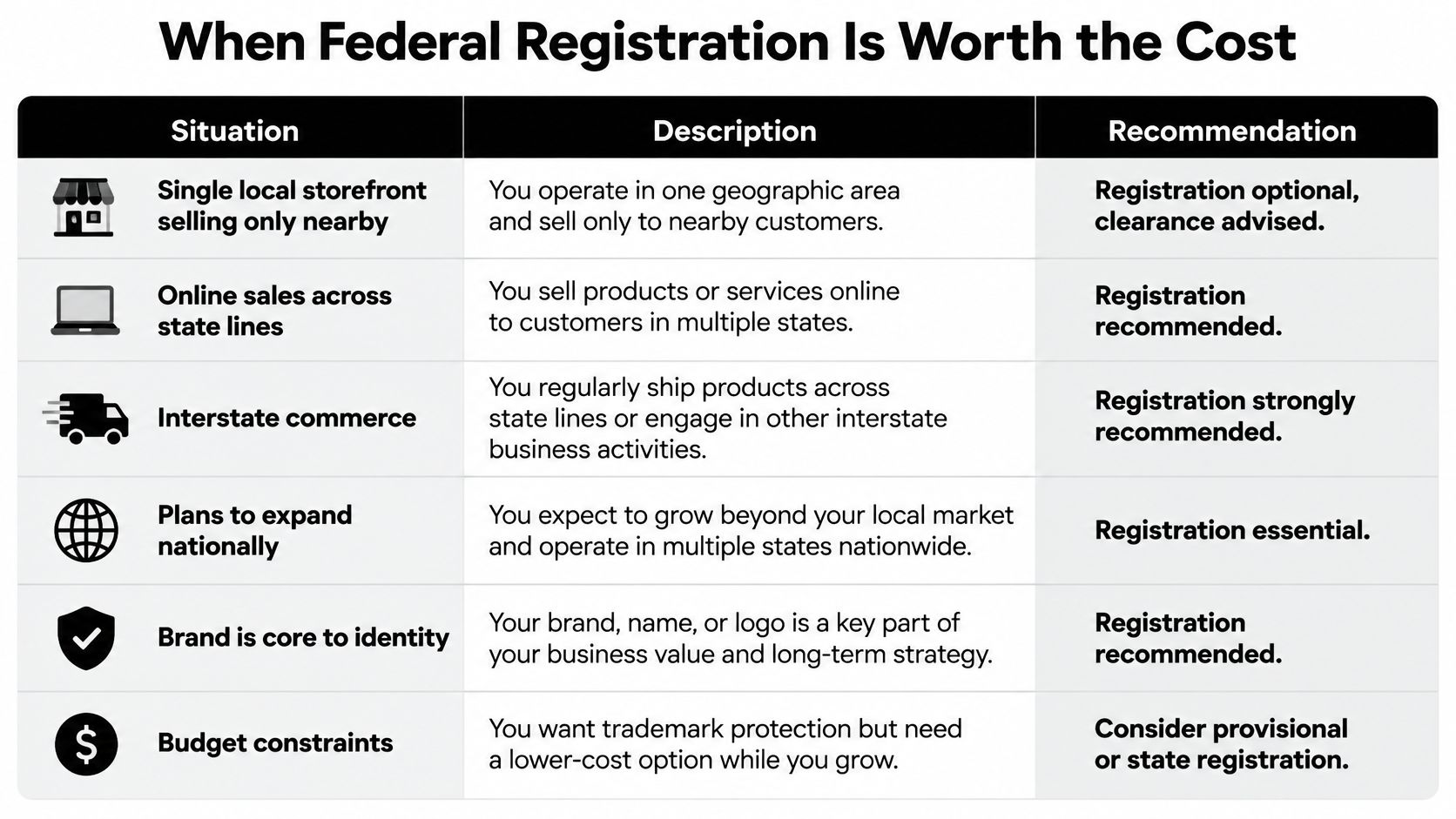
The gap between row one and row two is a shipping label. A Fort Lauderdale skincare brand selling through its own site and two marketplaces has customers in forty states without ever opening a second location. If a federal registrant in another state owns a confusingly similar mark for skincare, the unregistered brand is the one facing a demand letter, a marketplace takedown, and eventually a rebrand of labels it already printed.
What registration adds, concretely
The USPTO's Basic Facts booklet lists the practical returns: a legal presumption that you own the mark and the exclusive right to use it nationwide for the listed goods and services, public notice through a searchable database, eligibility for the ® symbol, and the ability to record the registration with U.S. Customs and Border Protection against certain infringing imports.
Territory cuts both ways. WIPO's guide to trademark rights explains that rights are territorial and that registering a business or trade name doesn't automatically protect it as a trademark. Filing volume isn't shrinking either: USPTO figures reported in that WIPO guide show applicants filed more than 824,000 new trademark classes in fiscal year 2025, a 7.4% increase from fiscal year 2024. Every month you wait, more names enter the register.
Naming and identity decisions come before any of this. If you're still settling on a name, branding advice from DesignStack helps you build one that reads as a brand rather than a generic label, which is exactly what makes it registrable later.
Sequencing tip: When two rows apply to you, follow the earlier deadline. A founder who plans to license next year and launch nationally in March is really working to the March date.
How to Clear Your Name Before Spending on Branding
Clearance is the cheapest step in the entire process and the one founders skip most often. Order packaging first and a search problem becomes a rebrand problem.
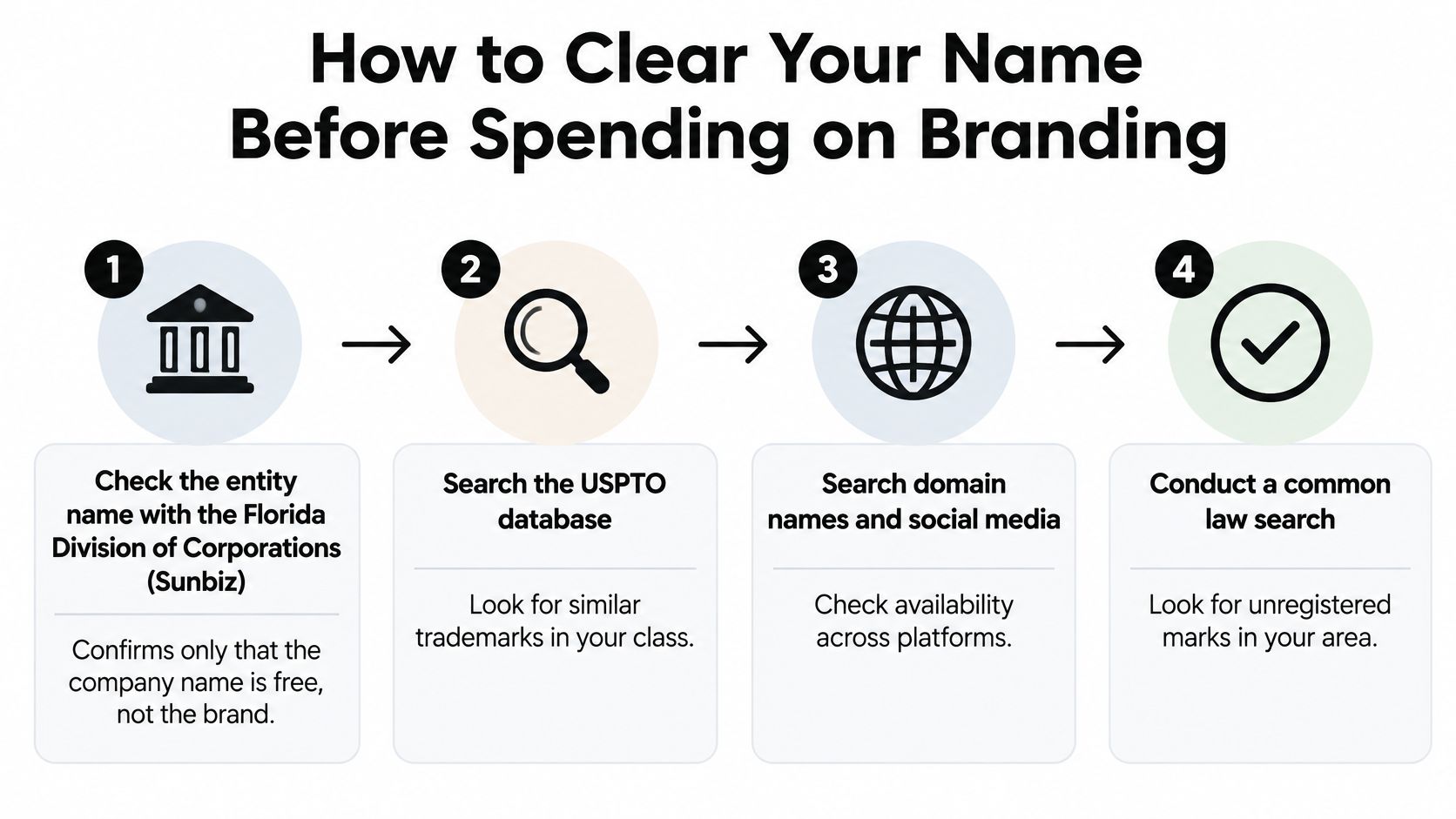
Run these six checks in order, and log what you find at each one.
- Confirm the entity name on Sunbiz. A Florida Division of Corporations search tells you whether the LLC or corporation name is free for registration. It tells you nothing about whether the brand is safe to use, and that distinction trips up more founders than any other.
- Search the USPTO database for near matches. Search the exact name, then the sound-alikes, the one-letter variants, and the plural. An exact-match search returns a clean result and a false sense of security, because the conflicts that matter are confusingly similar, not identical.
- Search beyond federal records. Check web results, app store listings, marketplace sellers, and social handles. A business using your name without a registration can still hold common-law rights in its region, and those rights can complicate your expansion even if no federal mark exists.
- Check the domain and the handles. Availability here matters for launch and marketing, but treat it as a separate check. A .com being free says nothing about whether someone owns the trademark.
- Confirm the name works as a brand. It has to appear on products, labels, or a service page in a way customers read as source identification. Per the USPTO's Basic Facts guide, merely using a business name doesn't necessarily constitute trademark use, and state business-name authorization creates no trademark rights.
- Record every result with a date and a screenshot. Save the search pages as PDFs. If you later need to explain why you adopted a name in good faith, that folder does the explaining for you.
Before you spend: Run the full search before you print packaging, order a storefront sign, or pay a designer for a label system. Those are the costs that can't be recovered.
What a clean result looks like
A clean result isn't "no identical hits." It's no identical or confusingly similar mark for the same goods or services, in your class, in a way a customer would misread. If a similar name exists but sells something unrelated, note it and move on.
Clearing the name is also separate from protecting the artwork. When you reach that stage, how to trademark a logo covers the design-mark side, which usually comes after the name.
If the search turns up a conflict, treat it as a naming problem rather than a stubbornness problem. Brand naming strategies from Advisor Momentum can help you rebuild the shortlist around names distinctive enough to own.
Choosing the Right Filing Basis and Owner
Two questions decide your filing basis. Is the name already selling or advertising something? If not, is there a real launch date behind it?
| Filing basis | When it fits | What it requires |
|---|---|---|
| Use in commerce | The name is already used in sales or advertising across state lines, to customers outside your state, or in U.S. commerce with another country | Dates of first use plus a specimen showing the mark as actually used |
| Intent to use | Launch is planned and funded, but no qualifying use yet | A bona fide intent to use, then a statement of use after the notice of allowance |
Specimens are where use-based applications fail. Per the USPTO's guidance on filing basis, a service specimen generally needs a web page or advertising that identifies the business and describes the offered services, and it has to satisfy USPTO requirements rather than display a corporate name. A screenshot of your homepage logo is not enough if the page never says what you sell.
Intent-to-use buys time and priority at the same time. The filing date generally gives you priority over later applicants, and after publication the USPTO ordinarily issues a notice of allowance. From there you have six months to file a statement of use or request a six-month extension, with further extensions available inside statutory limits.
Owner and class, the two details that sink applications
File in the name of the entity that will control the brand, not whichever founder happens to be signing. An application filed personally by a founder who later forms an LLC means an assignment down the road, and investors notice that kind of loose end during diligence.
Then count your classes with care. A Miami software company filing for a downloadable app and for consulting services is describing two legally distinct offerings, which means two classes and two fees. Splitting them is correct, not aggressive.
Drafting tip: Write your goods and services list in plain English first, then compare it against the USPTO's standard wording. Precise language that matches an accepted identification saves money and shortens examination.
What Filing and Attorney Work Typically Cost
Government fees are the only fixed number in the process, and they changed on January 18, 2025. Everything else depends on how complicated your filing turns out to be.
| Charge | Amount | When it applies |
|---|---|---|
| Base electronic application fee | $350 per international class | Every class covered by the application |
| Insufficient information surcharge | $100 per class | Required information missing at filing |
| Free-form text box surcharge | $200 per class | Free-form text used instead of standard identifications |
| Extra characters in certain fields | $200 per additional 1,000-character group | Long text beyond the first 1,000 characters in specific fields |
The USPTO trademark dashboard sets out the current schedule behind those numbers. Because fees are charged per class, a two-class application runs $700 in base fees before any surcharge appears, and a sloppy goods description can add hundreds more on top.
Costs the government schedule doesn't show
The filing fee is one line in a longer budget. The rest:
- Clearance searching. A thorough search, including common-law sources, costs money and prevents the expensive version of this problem.
- Drafting and filing. Attorney time to identify the right classes and write an identification the examiner will accept.
- Office action responses. Examiners refuse applications for descriptiveness, likelihood of confusion, and specimen problems. Each response is billable work.
- Maintenance. Declarations and renewals at five and ten years, filed on time.
Budgeting tip: Nail down the exact goods or services before you file anything. Incomplete information or unnecessarily broad wording raises both the fee and the examination risk.
The mechanics of assembling an application for a Florida business, from identification drafting to submission, are covered in this guide to the Florida trademark application process.
Before you budget, check the live fee schedule rather than a blog post, including this one, and ask whether the name is distinctive enough to justify the spend at all. A descriptive name can cost more to register and protect less once it issues.
Keeping Your Registration Active Through Renewals
Registration doesn't run on a fixed term and then lapse. It lasts as long as you keep using the mark and keep proving it, and the proof is due at fixed intervals, whether or not anyone reminds you.
| Deadline window | Filing required | Late surcharge |
|---|---|---|
| Between the fifth and sixth anniversaries | Section 8 declaration of use with a specimen per class | $100 per class during the grace period |
| Between the ninth and tenth anniversaries | Combined Section 8 declaration and Section 9 renewal | $200 per class during the grace period |
| Every ten years after that | Combined Section 8 and Section 9 renewal | Same grace-period surcharges apply |
The USPTO's guide to maintaining a registration confirms the sequence and the penalties. A Section 8 declaration requires a verified statement plus a specimen showing how the mark is used in commerce for each relevant class, along with the fee. A six-month grace period exists, but it costs extra: $100 per class for a late Section 8 and $200 per class for a late combined filing.
The cafe that kept a dead class
A cafe registered for its coffee drinks and for a retail line of packaged beans. Two years later it stopped selling the beans. Leaving that class in the registration means swearing, under verification, to use the mark on goods it no longer sells. Unused goods left in a registration create accuracy problems and give a challenger an opening.
Remove what you've abandoned. Pruning a class costs nothing; an inaccurate declaration costs plenty.
Upkeep habits: Calendar every deadline on the day the registration issues. Store dated specimens of real marketplace use as you go. Review each listed class before every filing instead of copying last cycle's list.
Do one thing today: put the fifth-anniversary date in a shared calendar with a named owner. Deadlines survive when one person is responsible and die when responsibility is assumed to be shared.
Confirm Your Clearance Before You Launch
You're at the decision point now, and it's a single question: does this name need federal protection in the next twelve months, judged by where your customers will be, not where they were last quarter. If the answer is yes, the sequence is clearance first, filing second, and packaging third.

Three habits carry the rest of it:
- Clear before you commit. Nothing printed, ordered, or installed until the search comes back usable.
- File before the conversation. Franchise, license, or investor discussions come after a filing, not before. Counterparties check the register during diligence.
- Document from day one. Invoices, web pages, and dated signage photos beat memory every time.
Early clearance and filing reduce rebranding risk and strengthen enforcement as the brand grows, online and off. That's why the work happens in that order.
If you want the search and the filing handled together, our team at Coto & Waddington, Attorneys at Law reviews search results and your planned goods or services before anything is submitted, then handles class selection, the USPTO filing, and any office action that follows. Our bilingual team works in English and Spanish with founders across Miami and Fort Lauderdale, and we handle state filings as well as federal ones. Early clearance is the difference between a name you own and a name you have to surrender.
A clean clearance result is the signal to file.
Trademark clearance is where a name gets tested, and it's the step most founders rush past on the way to launch. Coto & Waddington, Attorneys at Law handles clearance searches, registrability guidance, class selection, USPTO application filings, and office action responses for startups and creators across South Florida, in English and Spanish. Visit Coto & Waddington, Attorneys at Law to book a clearance review before you commit another dollar to the brand.