No, a lawyer is not legally required to file Florida Articles of Organization, and the basic state total is $125, which is a $100 filing fee plus a $25 registered-agent fee. You or any other organizer can sign the articles, name a registered agent, and submit them without counsel.
So why do founders who file alone sometimes end up across a table from each other a year later, holding a certificate of status and no agreement about who owns what? The filing is the smallest part of the decision. It creates a legal entity. It doesn't decide how that entity behaves when two people disagree, when a founder leaves, or when a tax election deadline slides past unnoticed. The question behind "do I need a lawyer to form an LLC" isn't the form. It's which parts of your business that form settles.
Table of Contents
- The Short Answer and Who Should Get Counsel
- What Filing Creates and What It Leaves Open
- DIY Formation Versus an Attorney, Side by Side
- Florida and Delaware Costs You Should Budget For
- Tax Elections and Deadlines That Can Change the Answer
- Three Founders Who Went Different Routes
- Confirm the Structure Before You File
The Short Answer and Who Should Get Counsel
Can you form a Florida LLC without hiring a lawyer? Yes. Florida law allows one or more people to form an LLC by signing and delivering Articles of Organization to the Department of State, as Florida Statutes section 605.0201 explains. The articles identify the company and its addresses, name a registered agent, and include that agent's written acceptance. Filing creates the LLC once the articles take effect and the company has at least one member.
That filing is a starting point, not a set of rules for running the business. The state filing process checks the forms; it does not settle ownership, management, or business strategy questions.
| Situation | Self-filing may work | Attorney review is advisable |
|---|---|---|
| One owner, no employees or investors | Yes, if the structure is straightforward | Optional |
| Two or more founders | Only after agreeing on written terms | Before filing |
| Investor-backed or planning to raise money | The structure may need careful planning | Yes |
| Family business with shared ownership | Written terms can clarify expectations | Yes |
| Considering an S-Corp election or contributing IP | Keep careful records and coordinate decisions | Yes, alongside a tax adviser |
| Foreign owners or multi-state operations | Requirements may vary | Yes |
The key distinction is how many people must agree on the rules. A solo owner can make decisions alone. Co-founders need to decide how ownership, contributions, and authority fit together, and what happens if they disagree or one wants to leave.
Two-minute test: Count the owners, list what each contributes, then write down who makes decisions and how the owners will handle taxes. If the answers are straightforward and everyone agrees, self-filing may be workable. If the answers require negotiation, get advice before filing.
Coto & Waddington provides small business legal services that include entity formation, operating agreements, and guidance on business structure. The value of legal help is in making deliberate choices about the rules behind the filing, not just submitting the form.
What Filing Creates and What It Leaves Open
The state filing creates the LLC as a legal entity. It does not set the owners' deal. Articles of organization are more like a building's official address than its floor plan: they establish the entity, while an operating agreement sets out how the owners will run it.

Filing alone does not specify ownership percentages, management rights, intellectual property ownership, or what happens when a member leaves. Those decisions need separate attention.
- Ownership split. Two members may assume they each own half. The articles do not necessarily record that understanding, leaving room for disagreement about what each person contributed and what share they receive.
- Voting and deadlock. One member wants to hire; the other wants to wait. Without agreed voting rules or a way to resolve a tie, the business may be stuck.
- Capital contributions. One founder contributes cash, while another contributes unpaid work. A written agreement can explain how each contribution affects ownership and decisions.
- Distributions and transfers. The owners can decide how profits are distributed and whether a member may transfer an interest to someone outside the business.
- Intellectual property and exits. If a founder creates the company's brand or other work, the owners should clarify whether it belongs to the individual or the LLC. Exit terms can also set out how a departing member's interest will be handled.
Consider a two-member LLC that files articles, opens a bank account, and operates for a year. One member then takes a salaried job and wants to leave. Without agreed terms for a buyout, valuation, or notice, the remaining member must negotiate the departure without a clear process.
A written operating agreement can address these questions before they become disputes. A business operating agreement template can help identify topics to discuss, but the owners still need to choose terms that fit their arrangement. Filing can be straightforward; deciding how ownership and management work takes deliberate thought. For a different comparison of ownership rules, see Mainland and Free Zone ownership rules.
DIY Formation Versus an Attorney, Side by Side
Two paths, same finish line, different artifacts left in the drawer. One produces a stamped certificate and whatever agreement you wrote yourself. The other produces a stamped certificate plus documents that answer the questions a dispute would raise.
The comparison below is about risk, not permission.
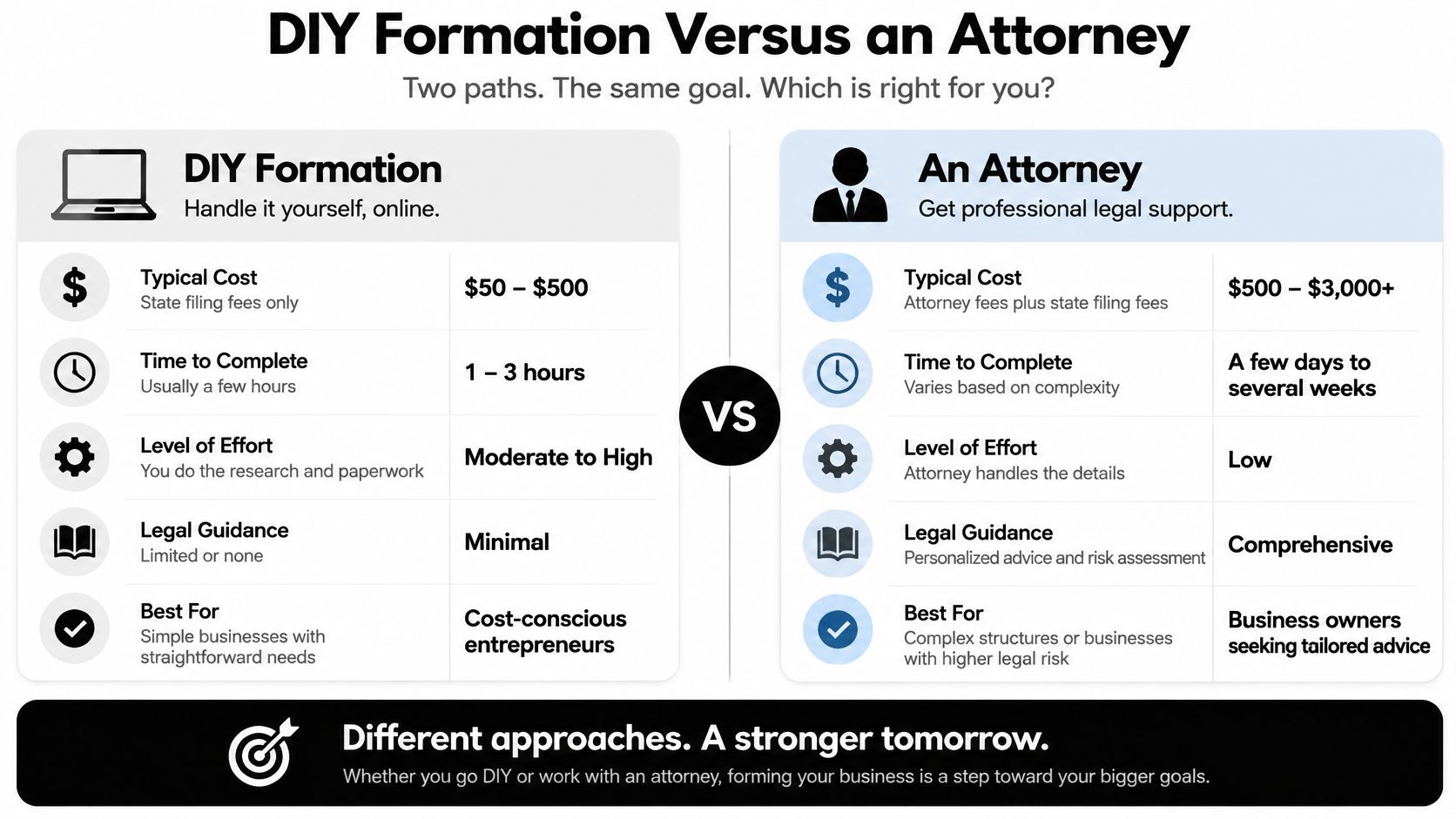
| Factor | Self-filed LLC | Attorney-led formation |
|---|---|---|
| Government fee | Identical, whichever path you choose | Identical, plus an attorney fee quoted separately |
| Operating agreement | Written separately, often from a template | Drafted to match ownership and management |
| Ownership and deadlock rules | Often left unaddressed | Written into governance terms |
| IP and contribution records | Easy to overlook | Documented and assigned at formation |
| Tax election coordination | Founder tracks timing alone | Coordinated with a tax adviser |
| Cost of fixing errors later | Can rise sharply after a dispute | Usually lower when handled at formation |
| Best fit | One owner, simple structure | Multiple owners, investors, employees or regulated activity |
Government fee. You pay the state the same amount either way, so this row is a tie and shouldn't drive the decision.
Operating agreement. A template gets you sentences. Drafting gets you sentences that match your actual ownership split, your management choice, and your state's default rules where the document stays silent.
Ownership and deadlock rules. This is the row that decides cases. A tie-breaking mechanism costs a paragraph to write at formation and costs a negotiation, or a lawsuit, to add later.
IP and contribution records. Assignments, schedules, and a contribution log take an afternoon at the start. Reconstructing them two years later, when a founder has moved and the code lives on three laptops, takes far longer.
Tax election coordination. One person has to own the calendar. When nobody does, the election deadline passes and the structure you built for tax reasons stops delivering.
Cost of fixing errors. A template that skips buy-sell mechanics can cost more to amend after a dispute than drafting fees would have cost at formation. That's the row to read twice.
Where the cheap path wins and where it doesn't
DIY is sensible for one owner with a simple service business, no employees, no investors, and no contracts that carry intellectual property. It's also fine for a side business that will never hold assets beyond a bank account.
It stops being sensible when money or IP changes hands between founders, when you plan to hire, when you operate in a regulated field, or when someone is putting in sweat instead of cash. The Small Business Administration's guidance on choosing a business structure identifies attorneys and accountants as useful advisors at exactly this stage. The Division of Corporations' own description of LLCs notes they carry fewer formalities than corporations, which is why self-filing works at all, and still advises contacting an attorney or accountant to confirm the structure fits the business.
Ask for a line-item quote. Government fees, drafting, registered-agent services, and ongoing support should appear as separate lines, so two quotes can be compared without guesswork.
A clear document list makes that comparison fair. Ask what you receive: articles, operating agreement, membership schedule, EIN confirmation, and a compliance calendar. If a quote can't name its deliverables, it isn't comparable.
Florida and Delaware Costs You Should Budget For
Florida's basic government cost for forming a domestic LLC is $125: a $100 filing fee and a $25 registered-agent fee, according to the Florida LLC fee schedule. Optional extras are $30 for a certified copy and $5 for a certificate of status. Ordering both raises the total to $160.
The recurring Florida cost is the annual report fee, currently $138.75, including the supplemental fee. Delaware's initial filing costs more than its basic filing fee suggests because an LLC also needs a registered agent with a physical Delaware address.
| Cost item | Florida | Delaware | Notes |
|---|---|---|---|
| Formation filing fee | $100 | $110 | Required for a new LLC |
| Registered-agent fee | $25 | Not a state fee, paid to your own agent | Florida requires a physical Florida street address |
| Certified copy | $30 | Not part of the $110 filing | Optional |
| Certificate of status | $5 | Not part of the $110 filing | Optional |
| Annual report or annual tax | $138.75 | $300 due June 1 | Recurring every year |
| Basic filing total | $125 | $110 plus agent | Excludes any attorney fees |
Delaware's Certificate of Formation filing fee is $110. Delaware LLCs also owe $300 in annual tax by June 1 each year after formation. Both states require a registered agent with an in-state physical street address. Delaware requires an authorized person to sign and file the certificate, but that person does not have to be an attorney.
The filing fee is only one part of the budget. Add the recurring state charge and any agent or legal fees to compare the likely first-year cost. State fees can change, so check the current schedule before filing.
Choosing a state also affects the structure you'll need to maintain. If investors or a future fundraising round are part of the plan, legal guidance can help assess whether Florida or Delaware fits. An operating agreement also sets how owners share costs and who handles obligations such as the annual report if a founder stops participating.
Tax Elections and Deadlines That Can Change the Answer
State formation and federal tax classification are separate decisions, made on separate forms, with separate deadlines. The IRS generally treats a domestic single-member LLC as a disregarded entity and a domestic multi-member LLC as a partnership, per the IRS guidance on LLCs. An LLC can instead elect corporate treatment using Form 8832, or S-corporation treatment using Form 2553 if it qualifies.
| Situation | Default treatment | Election available | Timing rule |
|---|---|---|---|
| Domestic single-member LLC | Disregarded entity | Form 8832 for corporate treatment | Generally no more than 75 days before filing or 12 months after |
| Domestic multi-member LLC | Partnership | Form 8832 for corporate treatment | Generally no more than 75 days before filing or 12 months after |
| Eligible LLC seeking S-corporation tax | Determined by its current classification | Form 2553 | Confirm the deadline with a tax adviser |
How the timing rule bites
An election generally cannot take effect more than 75 days before filing or later than 12 months after filing. That window makes deadline management an operational task, not a footnote. Miss it and you spend a year running payroll under a classification you didn't want.
The cause and effect is easy to state. Filing the entity correctly under state law does not ensure that the ownership structure, compensation model, payroll treatment, estimated-tax planning, or federal election timing is right. The articles can be perfect and the tax picture can still be wrong.
Counsel is most useful when founders contribute intellectual property, issue unequal membership interests, admit investors, operate across states, or want S-corporation taxation, because the operating agreement and capitalization records have to align with the election and the economics. A lawyer doesn't replace a tax professional. The working team is usually counsel for governance and liability structure plus an accountant for tax modeling and filings. If you're weighing the two structures, this comparison of LLC versus S-corp for small business lays out the trade-offs.
Calendar it before you form. Write the intended election and its filing deadline on the calendar the same week the articles go out. A deadline nobody owns is a deadline nobody meets.
Three Founders Who Went Different Routes
Three illustrations, three different fact patterns, three different answers to the same question. None of these are unusual.
The Miami freelance designer. She forms a single-member Florida LLC herself, files the articles, pays the state, and adapts a simple operating agreement from a template. No employees, no investors, no co-owners, one bank account. Self-filing was reasonable because her facts matched a simple structure, and the operating agreement existed even though the state didn't demand one.
The two co-founders with no agreement. They file articles in week one and start selling in week two. A year later they disagree about equity, about who approves hiring, and about whether one of them is still full-time. Neither can point to a document. Counsel drafts an operating agreement with ownership percentages, vesting, and dispute-resolution terms, which costs more to fix now than it would have cost to draft at the start.
The team heading toward a raise. Eight months in, they learn their LLC will need to convert to a corporation before a venture round, and that each founder must assign their IP to the entity. Planning those steps at formation is cheaper than unwinding them later, when contracts, bank accounts, and a trademark application all carry the wrong name.
Each story turns on one check that should have happened before filing.
- Designer: write down that there is exactly one owner and confirm the management structure in the operating agreement.
- Co-founders: put ownership percentages and vesting in a signed document before the first invoice goes out.
- Fundraising team: decide the entity and the IP assignment plan before taking outside money, not after.
The pattern: the founders who regretted self-filing didn't regret the filing. They regretted the conversation they never had.
Notice that none of these people needed permission to file. The state accepted all three sets of articles. What differed was whether the paperwork behind the filing matched how the business ran.
Confirm the Structure Before You File
A state filing creates the legal entity, but it does not settle every question about how the business will work. Before you file, make the key choices in writing. Each one informs the next.
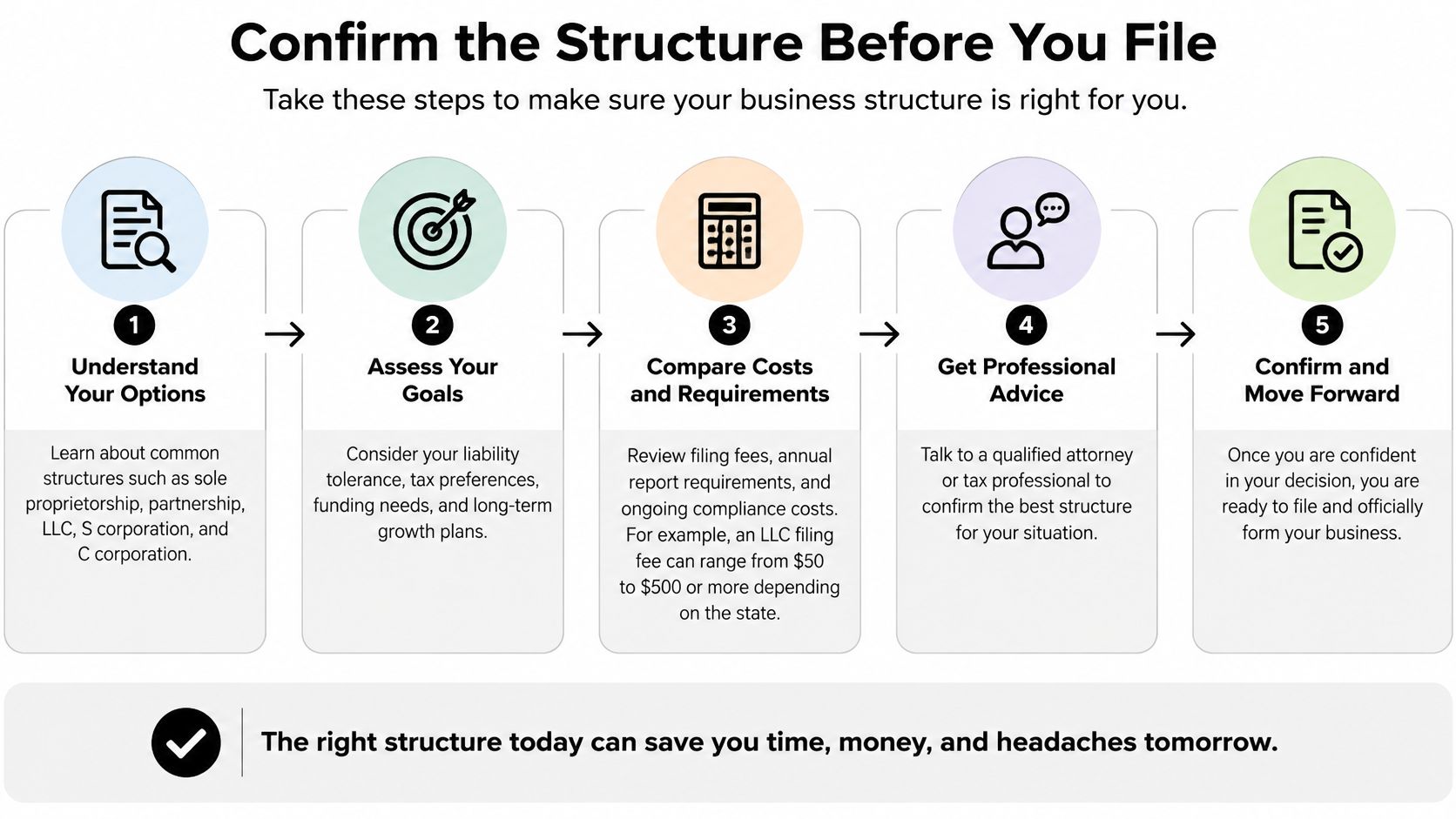
- List every owner and contribution. Record cash, equipment, a client list, a codebase, or unpaid work. These details can help owners decide how to divide ownership.
- Choose member-managed or manager-managed. In a member-managed LLC, the owners run the business. In a manager-managed LLC, appointed managers handle operations, while members vote on major decisions.
- Choose Florida or Delaware. Compare filing and annual costs, and consider whether investors expect a particular state.
- Name a registered agent. The agent receives official notices, including lawsuits. Confirm the agent's address and willingness to serve before filing.
- Decide whether to make a tax election. Coordinate with a tax adviser and calendar any applicable Form 8832 or Form 2553 deadline.
- Check current federal reporting requirements. FinCEN's March 26, 2025 interim final rule removed beneficial ownership reporting for entities created in the United States, including domestic LLCs. Different requirements may apply to qualifying entities formed under foreign law and registered to do business here, so check the rule's current status before relying on an older checklist.
- Choose whether to file yourself or hire counsel. Self-filing can make sense when ownership and management decisions are straightforward. Legal help can be useful when those decisions involve multiple owners, investors, or tax planning.
The first five steps clarify what the filing must reflect and what belongs in the operating agreement. If your ownership and management choices are simple, you may be comfortable filing on your own. If they require negotiation, settling them before filing can help prevent the state record and the owners' expectations from diverging.
For operational planning, an office cleaning startup checklist covers launch tasks such as licenses, accounts, and insurance. Those tasks are separate from deciding who owns the company, who manages it, and how profits and disputes will be handled.
For multiple owners, investors, or an ownership split that isn't obvious, Coto & Waddington, Attorneys at Law offers flat-rate packages that grow from formation into ongoing counsel. The firm handles LLC, S-Corp, and C-Corp formation through Sunbiz and the IRS, including formation documents, operating agreements or bylaws, and EIN registration. Most LLCs and corporations are registered in 3–5 days, with operating agreements and EIN filings completed shortly after.
If you want help choosing a structure, fill out the Need Legal Help form at Coto & Waddington, Attorneys at Law with your name, email, phone number, preferred language, legal matter, and message. The firm's lawyers will reach out. An attorney-client relationship forms only after a signed engagement agreement.