The most popular advice on this topic is also the most dangerous: just file one IRS form and you're a C corporation. That advice confuses a federal tax election with a state-law corporation, and it leaves founders taxed as a corporation while holding no stock, appointing no board, and producing records no investor can diligence. A company in that position hasn't finished a conversion. It's created a mismatch.
If you're going to convert LLC to C Corp status, I would treat it as two coordinated workstreams from the start. One track changes how the IRS taxes the business. The other creates the actual corporation under Florida or Delaware law, with authorized shares, bylaws, directors, and a stock ledger that matches the cap table. Run one track without the other and you'll spend the fundraising process fixing housekeeping instead of closing.
That distinction drives every decision that follows: which route you pick, which effective date you can legally use, whether the deemed transaction creates tax with no cash attached, and whether founder stock can even begin a potential QSBS holding period. Get the sequence right and the conversion is manageable. Get it backwards and the paperwork looks simple while the tax and ownership problems compound.
Table of Contents
- Pick the Route and Lock the Dates
- How to Convert an LLC to a C Corp Step by Step
- Tax Effects to Model Before the Conversion
- Investor Readiness and QSBS Timing
- Common Mistakes and How to Fix Them
- Confirm Your Route and Book a Conversion Review
Pick the Route and Lock the Dates
An LLC doesn't become a C corporation by filing one form. IRS Form 8832 changes federal tax classification. A state statutory conversion or a new incorporation creates the corporation itself. If you need to issue stock to investors, appoint directors, authorize an option pool, and deliver investor-ready records, you need the state-law route, not only the election.
Start with your current default. The IRS limited liability company guidance explains that a single-member domestic LLC is generally treated as a disregarded entity unless it elects corporate treatment, while a domestic LLC with two or more members is generally classified as a partnership unless it files Form 8832 to be treated as a corporation. Either type can elect corporate treatment. The number of owners tells you where you start, not where you must stay.
That distinction affects more than a return. A corporation-taxed LLC can still remain an LLC under state law unless you complete a statutory conversion, merger, or corporation formation. Your legal name, governing documents, equity records, securities issuances, contracts, licenses, and bank accounts don't magically update because the tax classification changed.
Conversion routes compared
| Route | What changes | State filing | Federal tax filing |
|---|---|---|---|
| Form 8832 election only | Federal tax treatment becomes a corporation; the entity stays an LLC under state law | None required by the state for the election itself | Form 8832, then Form 1120 from the effective date |
| Florida statutory conversion | The LLC becomes a Florida corporation | Approved plan of conversion and conversion filing with the state | Confirm with a tax adviser; Form 8832 if the route calls for it |
| Delaware statutory conversion | The LLC becomes a Delaware corporation | Conversion filing with the Delaware Secretary of State | Confirm with a tax adviser; Form 8832 if the route calls for it |
| New corporation and asset contribution | A new corporation receives the LLC's assets and liabilities for stock | Articles of incorporation plus asset transfer documents | Deemed contribution review, then Form 1120 |
Use the table as a test, not a menu. If your goal is only C-corporation tax treatment for a closely held business with no outside stock issuance planned, the election-only route may be enough for now. If venture investors, employee stock options, or a priced round are realistic, plan the Florida or Delaware corporation. A C-Corp, especially in Delaware, is common for startups seeking venture capital, while an LLC is flexible for many small businesses and an S-Corp may offer tax advantages in other settings. If you're still weighing the starting point, it helps to compare sole proprietorships and LLCs alongside the corporate options before you lock a structure you'll have to unwind.
Delaware deserves a deliberate comparison, not a reflex. Founders planning institutional funding often look at the benefits of Delaware incorporation because investors are familiar with Delaware corporate law and documentation. A South Florida operating business with local owners, no venture path, and Florida licenses may be cleaner as a Florida corporation. I would write the goal in one sentence before choosing. Raise venture capital, sell the business as stock, grant standard options, and Delware often wins. Operate locally and keep ownership simple, and Florida may win.
The dates that control the whole file
Pick the tax-effective date first, then align everything else to it. The IRS Form 8832 form and instructions state that the election's effective date generally may be no earlier than 75 days before the filing date and no later than 12 months after the filing date. An LLC filing on June 30 may generally choose an effective date no earlier than April 16 of that year and no later than June 30 of the following year.
Count backwards from the date you want. If you want corporate treatment to start with a new tax year, payroll cycle, or financing closing, schedule the Form 8832 filing so that date falls inside the window. Don't file the state conversion first and hope the tax date can be forced to match later.
Practical rule: Choose the desired tax-effective date before filing anything, and have your tax professional confirm whether you need Form 8832, a statutory conversion, or both.
There's also a lock-in to respect. After a classification change, the IRS generally restricts another classification election for 60 months, subject to limited exceptions. That means a rushed election can block a second restructuring you were planning for next year. Model the next financing, entity move, or ownership change now, while you still have choices.
Late-election relief exists in certain circumstances, but I wouldn't build a plan around it. Relief adds uncertainty at exactly the moment investors want clean records. File inside the normal window instead.
Timing gets easier when you separate filing speed from decision speed. Most LLCs and corporations are registered in 3 to 5 days, and operating agreements and EIN filings can be completed shortly after. The state isn't usually the bottleneck. The bottleneck is deciding the route, modeling the tax, and getting consents, assignments, and the cap table right before you file.
Tip: Schedule the conversion around fundraising and the tax year, not the reverse. If a term sheet is six months away, that's your working deadline, and the effective date, accounting cutover, payroll change, and contract assignments should all point to it.
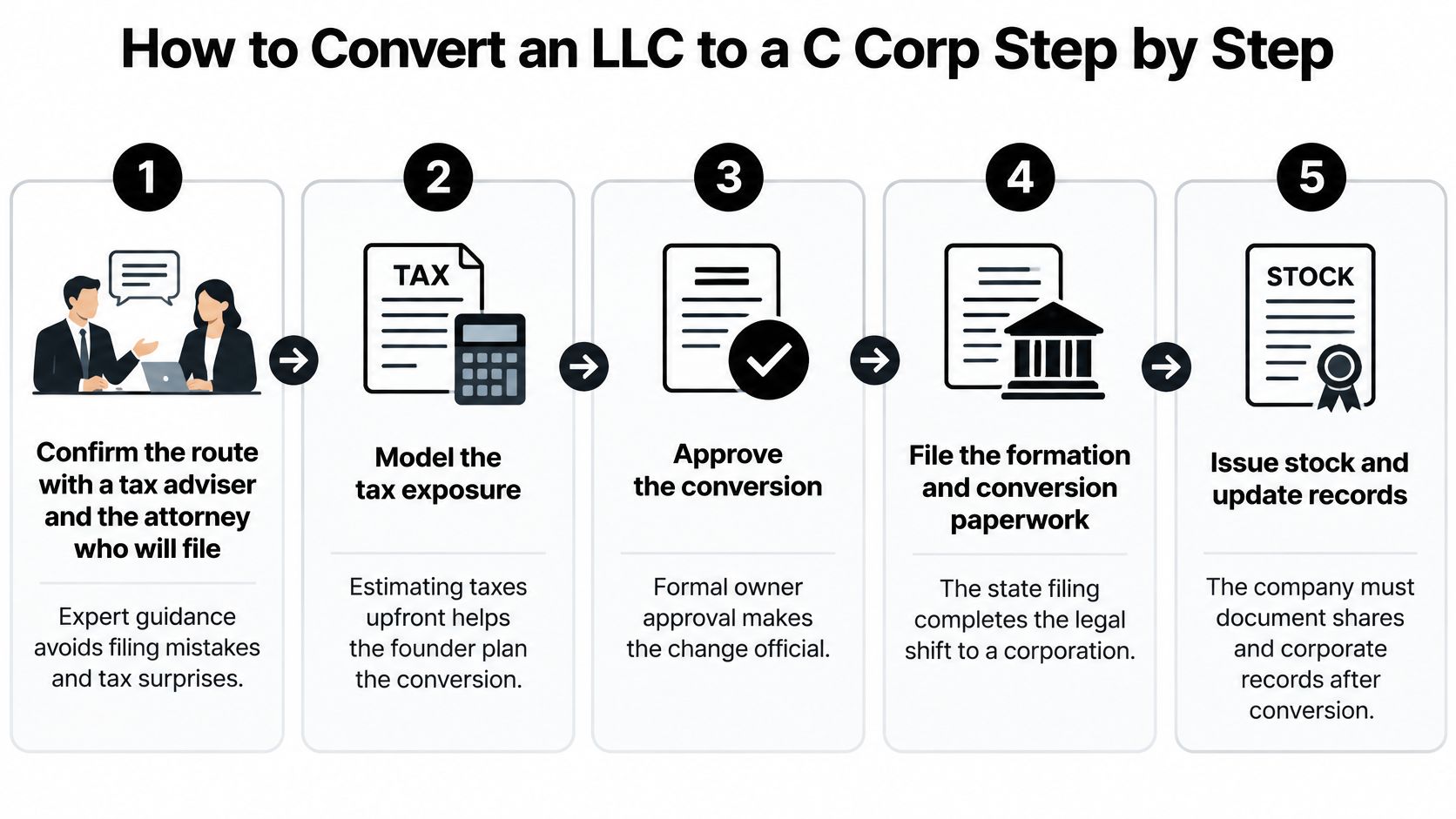
How to Convert an LLC to a C Corp Step by Step
Run the conversion in order. Skipping ahead to the state filing because it feels productive is how founders end up with a corporation on paper and unresolved tax exposure underneath it.
The sequence to follow
- Confirm the route with both advisers. Bring your tax adviser and the attorney who will file into the same conversation, because the tax election and the state conversion have to produce one consistent result.
- Model the tax exposure before you sign. Run the deemed-transaction numbers while you can still change the date or structure. Modeling after filing is damage assessment, not planning.
- Choose the tax-effective date and count back. Work from the date you want corporate treatment to begin, then set the Form 8832 filing date, payroll cutover, and books closing around it.
- Approve a written plan of conversion. Collect the member consent your operating agreement and state law require. The Florida conversion statute lays out a workflow that includes approving a written plan of conversion, obtaining required member consent, filing the conversion document with the state, and adopting articles, bylaws, director appointments, and an initial stock issuance schedule.
- File with the state. Submit the conversion document to the Florida Division of Corporations or the Delaware Secretary of State. That's the step that makes the entity a corporation under state law. If you're staying in Florida, align this with your Florida corporation filing requirements so the charter, registered agent, and initial reports don't drift apart.
- Adopt the governance package. Approve articles or a certificate of incorporation, bylaws, director appointments, officer appointments, and a stock issuance schedule. The state filing alone doesn't give you a functioning board.
- Issue the shares. Issue stock to match the agreed cap table, paper founder vesting, and record every issuance in the stock ledger on the day it happens.
- Move the operating assets and accounts. Transfer contracts, licenses, bank accounts, payroll registrations, and intellectual-property assignments into the corporation. When a startup converts for fundraising, we manage the conversion, prepare governance documents, and execute IP assignments as one package so nothing stays stranded in the old LLC.
- Close the tax loop. File Form 8832 when your route requires it, attach a copy to each direct and indirect owner's federal return for the tax year containing the effective date, close the final partnership or disregarded-entity return, and set up the first Form 1120 cycle.
What each step prevents
Steps 1 to 3 prevent the expensive surprise: a conversion that's legally done but tax-inefficient or timed outside the permitted window. Steps 4 to 6 prevent the governance gap, where the state has a corporation but the company has no validly appointed directors to approve the stock it's issuing. Steps 7 to 9 prevent the diligence gap, where the ledger, the tax filings, and the actual contracts tell three different stories about who owns the business.
Don't treat step 8 as clerical cleanup you can defer. A customer contract, lease, or core software assignment still sitting with the LLC after the effective date gives an investor's counsel a reason to pause the closing and ask who really owns the revenue. Move the assets that produce income first, then work through vendors, permits, and insurance.
The state filing dates, the tax election, and the books must all describe the same conversion on the same date. If they don't, stop and reconcile before you issue another share.
Tip: Keep one dated checklist that names the owner of each step, the filing confirmation, and the date the corresponding ledger, payroll, and bank changes were made. When diligence starts, that checklist becomes your index.
I would not sign investor documents until steps 1 to 7 are complete and documented. You can negotiate terms while the conversion is underway, but issuing promises against stock that doesn't yet exist invites exactly the corrections that delay a closing.
Tax Effects to Model Before the Conversion
A conversion can create taxable gain even when no cash changes hands and the same people own the same business the next morning. That's the risk to model before you convert LLC to C Corp status, not after the certificate comes back.
The IRS LLC tax guidance describes the deemed transaction for a partnership-classified LLC as the partnership contributing all assets and liabilities to the corporation in exchange for stock, followed immediately by liquidation and distribution of that stock to the partners. Once the election takes effect, the business generally files Form 1120 under corporate tax rules. You're not renaming the entity for tax purposes. You're running assets, debt, and ownership through a deemed contribution and liquidation.
Tax items to check before conversion
| Item | Why it matters | What to check |
|---|---|---|
| Built-in gain | Appreciated assets can be treated as contributed at fair value | Fair market value versus tax basis for each major asset |
| Liabilities above basis | Debt above basis can create taxable gain | Total liabilities compared with each owner's basis |
| Owner basis | Sets gain or loss on the stock each owner receives | Capital accounts and prior distributions for each owner |
| Net operating losses | Treatment depends on the structure chosen | Prior-year loss schedules and any limitations |
| Installment obligations | Deferred sales can create tax when the entity changes | Notes receivable and deferred payment contracts |
| Payroll and state tax accounts | Accounts must line up with the new entity | Employer identification, state registrations and open returns |
Work the table asset by asset. Software, developed intellectual property, equipment, and customer relationships may sit on the books at a low tax basis while carrying real economic value. A business that looks asset-light can still hold significant built-in gain in code its founders built and expensed along the way.
Then compare debt against basis owner by owner. Venture debt, a drawn credit line, financed equipment, accrued obligations, and years of member distributions can push assumed liabilities above basis. That's the classic trap: gain recognized at conversion, no sale proceeds to pay it with.
A short example
Say two founders own an LLC equally. The business holds self-developed software and equipment worth far more than their remaining tax basis, plus a credit line the company used to fund growth and distributions. On paper the conversion is just the two of them exchanging membership interests for stock in the same proportions. In the deemed transaction, though, the partnership contributes appreciated assets and the debt, receives stock, and distributes that stock in liquidation.
The chosen effective date can change who recognizes gain and in which tax year, especially if the founders took uneven distributions or one founder's capital account is lower than the other's. A date that looks tidy for payroll may land the gain in a year when one founder has no cash set aside for it. Run both founders' numbers separately. An entity-level estimate that averages them hides the person who gets hurt.
A single-member LLC needs a different analysis because it's generally disregarded before the election. There's no partnership liquidation to model, but basis in contributed assets, liabilities, and documentation of the resulting stock still matter. Don't copy a multi-member checklist onto a single-member file and assume you've covered it.
Don't forget the unglamorous accounts. Confirm how payroll tax accounts, state registrations, sales tax permits, and any open returns carry into the corporation, and whether a new employer identification number or fresh state registrations are needed for your route. A mismatch there creates notices that arrive months later, when everyone's attention is on the raise.
Close the modeling with a closing memorandum. Record the legal effective date, the tax effective date, the deemed asset-transfer analysis, stock percentages, authorized shares, issued shares, the option pool, and every required consent. Check it against the capitalization table and your financing and restricted-transfer clauses before anyone signs.
Tip: Have your tax adviser run the numbers on paper, owner by owner, before the state filing is submitted. Changing a date on a draft costs nothing. Changing it after filing can cost a tax year.
Investor Readiness and QSBS Timing
Converting later can delay the start of a potential QSBS holding period, and converting too early can saddle an operating business with corporate tax, compliance costs, and limits on distributions years before any exclusion is realistic. The convert-before-fundraising slogan ignores this tradeoff. Let the tradeoff set your timing.
Qualified small business stock depends on stock issued by a domestic C corporation that meets an active-business and eligibility framework under Section 1202 of the Internal Revenue Code. The exclusion percentage and the asset and activity requirements that apply to your shares depend on which version of the statute governs the issuance date, and those terms have changed over time. Confirm the rules in effect when the corporation issues the stock, rather than assuming the terms you read about will still be the terms that govern your exit.

The holding-period clock belongs to the stock, and stock exists only once the corporation issues it. For a holder who came in through the LLC, the deemed exchange at conversion is the event that produces the shares the statute evaluates. That makes the corporate issuance its own workstream for QSBS purposes, running alongside the state-law conversion and the federal tax analysis rather than inside either one.
Four scenarios to model
- Equity issued before conversion: Membership interests aren't corporate stock. The relevant question is what stock the holder receives at conversion, when it's issued, and what basis and value support it. Don't assume years spent as an LLC member automatically count the way you want.
- Equity issued after conversion: Founder and investor shares issued by the new corporation are easier to document for issuance date, consideration, and basis. This is the cleaner record, provided the corporation meets the eligibility requirements at issuance.
- SAFEs and convertible notes: Instruments written against an LLC may need amendment, exchange, or conversion mechanics that match corporate stock. The QSBS analysis turns on the specific stock ultimately issued, so the date money first arrived is the wrong input. Paper this before closing, and make any later stock purchase agreement reflect the same issuance facts.
- Redemptions and founder stock issues: Buybacks, cancelled interests, and reissued founder shares can complicate eligibility and the holding-period record. Document why each redemption happened and how replacement shares were authorized.
Keep the federal analysis separate from state tax treatment. A federal QSBS position doesn't answer how Florida or another state treats the same gain. Run both, and don't let a promising federal projection justify a conversion the operating business can't support.
Build the proof file while the facts are fresh. Keep contemporaneous records showing the issuance date, the shareholder, consideration paid, basis, gross assets at issuance, and active-business compliance. Board consents, the stock ledger, subscription documents, and a conversion-date balance sheet belong in one file. Nobody reconstructs this reliably years later during exit diligence.
QSBS eligibility depends on the specific stock issuance, shareholder, holding period, business activity, asset threshold, and documentation. The date the LLC filed an election is only one input.
I would also test whether a qualifying exit is the plan. A family business that expects to distribute cash for decades and never sell stock may pay corporate costs for a benefit it'll never use. A venture-track startup with a realistic stock sale has the opposite math. The same conversion can be smart for one and wasteful for the other.
Tip: Don't rely on convert-before-fundraising as your QSBS strategy. Model each issuance separately, then decide whether converting now improves the outcome enough to justify corporate tax and compliance today. This is planning context; get advice on your specific shares before you file.
Common Mistakes and How to Fix Them
The costliest mistake is treating Form 8832 as the whole conversion. The symptom is a company that's taxed as a corporation but has no stock, no board, and no bylaws. Investors can't buy shares that were never authorized, and founders can't prove who owns what. The fix is to complete the state conversion or formation separately and confirm that stock, bylaws, and directors exist before you promise equity to anyone.
The rest of the damage usually comes from records that drift apart, not from one dramatic error.
Symptoms, causes, and fixes
- Mismatched effective dates: The state filing, tax election, payroll change, and ledger each show a different conversion date because each adviser picked a date independently. Fix it with one closing memorandum that every filing references, then correct the books to that date and document the correction.
- Contracts still in the LLC name: Customer agreements, leases, bank accounts, and licenses keep running under the old entity because nobody owned the assignment list. Send assignment and notice letters, get counterparty consent where the contract requires it, and check change-of-control clauses in loan and lease documents before the effective date, not after a lender objects.
- Cap table doesn't match issued shares: The spreadsheet shows percentages, but the stock ledger shows different numbers, missing issuances, or shares promised by email. Reconcile the ledger, board consents, and cap table before investor diligence starts. Fixing it during diligence reads as a control problem, not a typo.
- Missing owner copies of Form 8832: The election was filed, but direct and indirect owners never received copies for their returns. Use a distribution checklist that names every owner, the date each copy was sent, and confirmation of receipt.
- Intellectual property left behind: Founders, contractors, or the old LLC still hold code, trademarks, or domain names personally. Execute written IP assignments into the corporation and record trademark assignments where needed. An investor will check the chain of title for the assets that make the company valuable.
- Old tax accounts left open: The final pre-conversion return isn't filed, or payroll and state accounts stay active under the prior structure. Close out the final return, issue final information statements to owners, and confirm which state accounts close and which carry over.
Notice the pattern. None of these failures requires bad faith or a complicated transaction. They happen when the founder treats the conversion as a filing event instead of a closing, with the same discipline you'd apply to a financing: a checklist, an owner for each item, and evidence that it's done.
Repairs are possible, but they get more expensive once a third party is relying on the records. Correcting a ledger before a raise is housekeeping. Correcting it after investors have wired money against the wrong share count is a negotiation.
Conversion binder rule: Keep dated copies of every filing, consent, election, assignment, and ledger update in one place. A clean record is what investors and acquirers check first.
Tip: Audit yourself the way diligence counsel will. Pick five items at random from the binder and confirm each one matches the cap table, the ledger, and the tax file. If two don't match, you don't have a filing problem. You have a records problem, and it's cheaper to fix now.
Confirm Your Route and Book a Conversion Review
You have three decisions to make, in this order. Which route fits your goal: election only, Florida corporation, Delaware corporation, or a new corporation that receives the assets. Which tax-effective date you can hit inside the permitted window. And whether that timeline matches your next raise or sale, with enough room to fix basis, contract, and cap table problems before a third party finds them.
Don't make those decisions from memory. Gather the documents that answer them, and bring the gaps with you rather than smoothing them over.
What to gather before the first call
- Operating agreement: The current, signed version with all amendments, so required member consents and transfer restrictions are clear.
- Cap table: Every owner, percentage, profits interest, SAFE, and convertible note, including anything promised but not yet papered.
- Asset and basis list: Major assets, intellectual property, equipment, and debt, with approximate tax basis for each so the deemed-transaction exposure can be modeled.
- Recent tax returns: The last two years of entity returns and owner information statements, plus any loss schedules.
- Loan and lease agreements: Anything with change-of-control, assignment, or lender-consent language that a conversion could trigger.
With that package, a review can do real work in one pass. For a new LLC, S-Corp, or C-Corp in Florida, we guide clients through the options and implement the structure that fits them. At Coto & Waddington, Attorneys at Law, our attorneys are University of Miami School of Law graduates focused on small business and startup law, and we offer flat-rate legal packages that evolve with a startup, from initial formation to long-term general counsel support. Confirm scope, fees, and timing on the call before you engage anyone, including us.
I would book that review before the first board consent or investor document is signed. Once you've issued stock promises, signed a term sheet with a closing date, or told a lender the conversion is done, your room to change the route or the effective date narrows fast. The review is where you choose the route while all four options are still open.
Tip: Book the review six to twelve months before a raise when you can. That window leaves room to model the tax, clean up IP assignments, reconcile the cap table, and pick an effective date deliberately instead of accepting whatever date the filing window leaves you during a financing.
If your raise is sooner than that, book anyway and say so. A compressed timeline changes the advice: which route can close cleanly, which fixes are essential before signing, and which can be scheduled as post-closing covenants. What you shouldn't do is let a closing deadline make those choices for you.
To request a review, use the contact information on the firm website and bring the five items above. You'll leave with a route, a target effective date, and a list of fixes ranked by whether they'd block a closing.
If you're planning to convert LLC to C Corp status for a raise, a stock sale, or employee equity, Coto & Waddington, Attorneys at Law can review your route, target effective date, and diligence gaps before you file anything. Bring your operating agreement, cap table, and recent returns, and we'll map the Florida or Delaware conversion against your financing timeline. Visit Coto & Waddington, Attorneys at Law to book your conversion review.